CMAX Agentic SEO Platform Data Links 268% Faster Zero-Click Impression Growth to AI Query Fan-Out
Just another WordPress site

Press Release Disclaimer: This is a press release distributed through the XPR Media network. It has not been independently verified by our newsroom.

SYDNEY, Australia – September 15, 2026 – CMAX, the agentic SEO platform built by search agency Area Ten, has published performance data drawn from its client portfolio comparing pages that run its content agents against pages on the same websites that do not. The measurement covers 14 client websites in ecommerce, finance, professional services and SaaS, seven in Australia and seven in the United States, between September 2025 and July 2026. Pages carrying CMAX long-tail content grew Google Search impressions 268% faster than non-CMAX pages on the same site. Those pages also began ranking for new queries 229% faster.
The finding CMAX considers most significant is where that impression growth landed. It sat in zero-click impressions, meaning the pages were served in response to a query and recorded no click. Area Ten reads that signature as retrieval by an AI engine rather than browsing by a person. When an AI assistant answers a question, it issues its own searches, pulls the results it needs and returns an answer inside its own interface. The page supplying the material registers the impression in Google Search Console and never receives the visitor. That holds whether the answer surfaces in Google’s AI Overviews, in AI Mode, or inside an assistant’s own interface.
The same-site structure of the comparison is what gives the figures meaning. Domain authority and site architecture are held constant because both sets of pages sit on one website. The variable is whether long-tail content was deployed to the page and kept current afterwards.
What an agentic SEO platform is
An agentic SEO platform uses autonomous software agents to deploy and continuously update content across a website, rather than generating a one-time batch of content or handing a list of recommendations to a human team. A one-time content generator publishes and stops. An agentic SEO platform keeps revising what it published, using performance data from search and AI engines as the input.
The shift has collected a set of names: generative engine optimization (GEO), answer engine optimization (AEO), AI optimization (AIO), AI search optimization and LLM SEO. They all describe the same work. Getting into an AI answer means ranking for the sub-queries an AI agent runs when it breaks a question into many, and those sub-queries are long-tail. Optimizing for query fan-out is long-tail keyword targeted SEO, at a scale the discipline has always required and rarely received. The acronyms are new. The work underneath them is not.
CMAX agents inject content into new and existing pages for the query variations customers actually use, then re-optimize that content on a rolling basis. The content is self-updating rather than written once and left. After six to eight weeks, the content on a given page has usually changed based on what that page’s own performance data showed. Content freshness carries more weight in Google’s ranking systems than many operators account for.
Query fan-out: how AI agents search
The mechanism behind the data is the structure of search demand. Over 90% of search and AI demand sits in the long tail, in the many low-volume ways customers describe what they want rather than in the handful of head terms brands compete over. Public benchmarks point the same way: 46.9% of Amazon’s non-brand organic search traffic comes from long-tail pages.
Most brands capture a small fraction of their category’s search demand even when they rank first on their most important terms. Nike ranks number one for running shoes in the US, yet according to SEMrush it captures around 70,900 visitors a month from non-brand searches related to running shoes, out of more than 8.5 million monthly US searches in the category. That is under 1% of the actual search demand, for the most dominant brand in the market both offline and online.
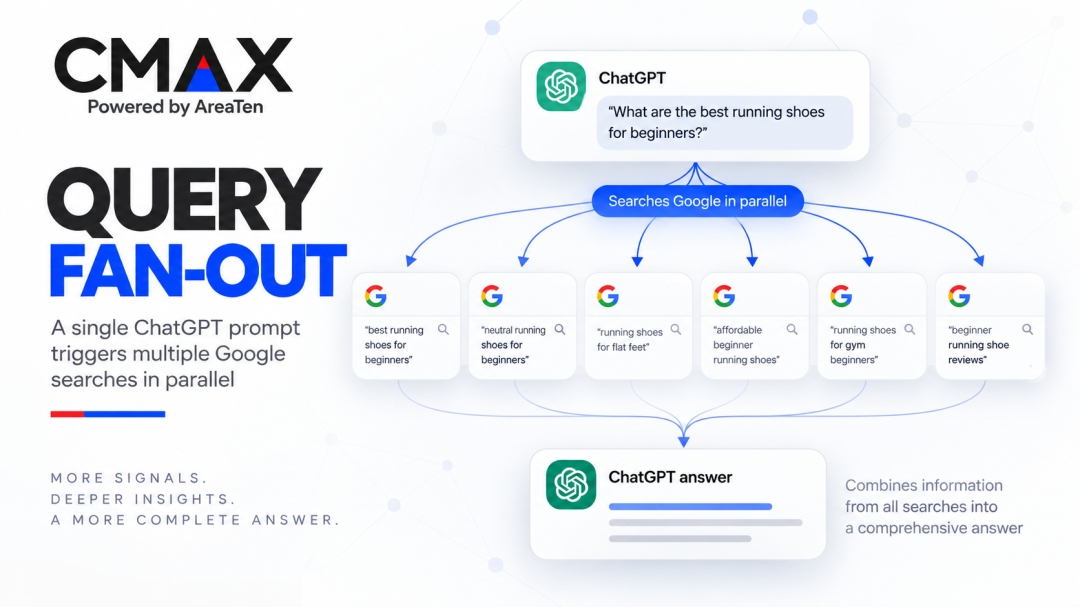
AI agents widen the same gap, through a mechanism the industry calls query fan-out. Query fan-out is the process by which an AI agent decomposes a single question from a user into multiple separate search queries, runs each one, and assembles an answer from what comes back. One question typically becomes eight to twelve queries, averaging around ten.
The retrieval layer underneath that process is Google. When an AI agent needs information it does not hold, it searches for it, and the index it searches is in most cases Google’s. AI is a new interface to Google search rather than a replacement for it. That is why long-tail ranking on Google still determines whether a brand appears in an AI answer, and why a brand with coverage on one head term and nothing underneath it is absent from most of the fan-out. The agent asked ten questions. The brand could answer one of them.
A brand’s AI visibility is therefore a function of how many of those sub-queries it can answer, which is a coverage question rather than a ranking question.
That is the link CMAX draws between its two findings. A page that gains impressions without clicks is being read by something that does not click, and the volume of those impressions tracks how many of an agent’s fan-out queries the page can answer. Under this reading, zero-click impression growth is the closest available proxy for AI search visibility in a tool marketers already have open, and it requires no prompt-tracking software to produce.
“Every brand we look at has the same shape of gap,” said Jeremy Tang, founder and CEO of Area Ten. “They rank for the terms they chose to fight for, and they are invisible across the thousands of queries they never covered. What changed with AI is that the invisible part is now where the answers get assembled. The clearest evidence we have is the zero-click pattern. Those pages are being picked up and used, and the visit never arrives, which is exactly what you would expect if the page is feeding a fan-out rather than a browser.”
How the platform is deployed
CMAX integrates with any CMS, with JavaScript and server-side implementation options, and requires no site migration. Client programs typically show first clicks in six to eight weeks and mature around month six, ahead of the six to twelve month timeline conventional SEO programs quote. The compression comes from working at query scale, deploying coverage across thousands of query variations at once rather than optimizing a page at a time.
For clients in legal, medical, finance and listed-company settings, CMAX uses custom language models trained only on approved client content rather than off-the-shelf general models, which limits hallucination and brand-safety risk when content is deployed at scale.
Around 60 million visitors a month flow through CMAX client websites across ecommerce, finance, medical, legal, education and IT.
About CMAX
CMAX is an agentic SEO platform for search and AI visibility. Its agents deploy and continuously update long-tail content across a client’s new and existing pages, covering the query variations customers use across Google and AI engines such as ChatGPT, Perplexity and Gemini. CMAX was built by Area Ten, a search agency founded in 2014 by search practitioners with more than 22 years in enterprise SEO, running programs for large national and global brands across retail, finance, healthcare, telecommunications and technology. The company’s stated mission is to give brands coverage across the full range of ways customers search, rather than the narrow set of head terms conventional SEO programs target.
Media Contact
Company Name: CMAX.ai
Contact Person: Jeremy Tang
Email: Send Email
Country: Australia
Website: https://www.cmax.ai/
Press Release Distributed by ABNewswire.com
To view the original version on ABNewswire visit: CMAX Agentic SEO Platform Data Links 268% Faster Zero-Click Impression Growth to AI Query Fan-Out