
Online Food Safety Courses That That Teach Food Safety Plan and HACCP Plan Development
eHACCP.org offers HACCP training that not only offers an IHA accredited Certificate of Completion but effectively

Press Release Disclaimer: This is a press release distributed through the XPR Media network. It has not been independently verified by our newsroom.
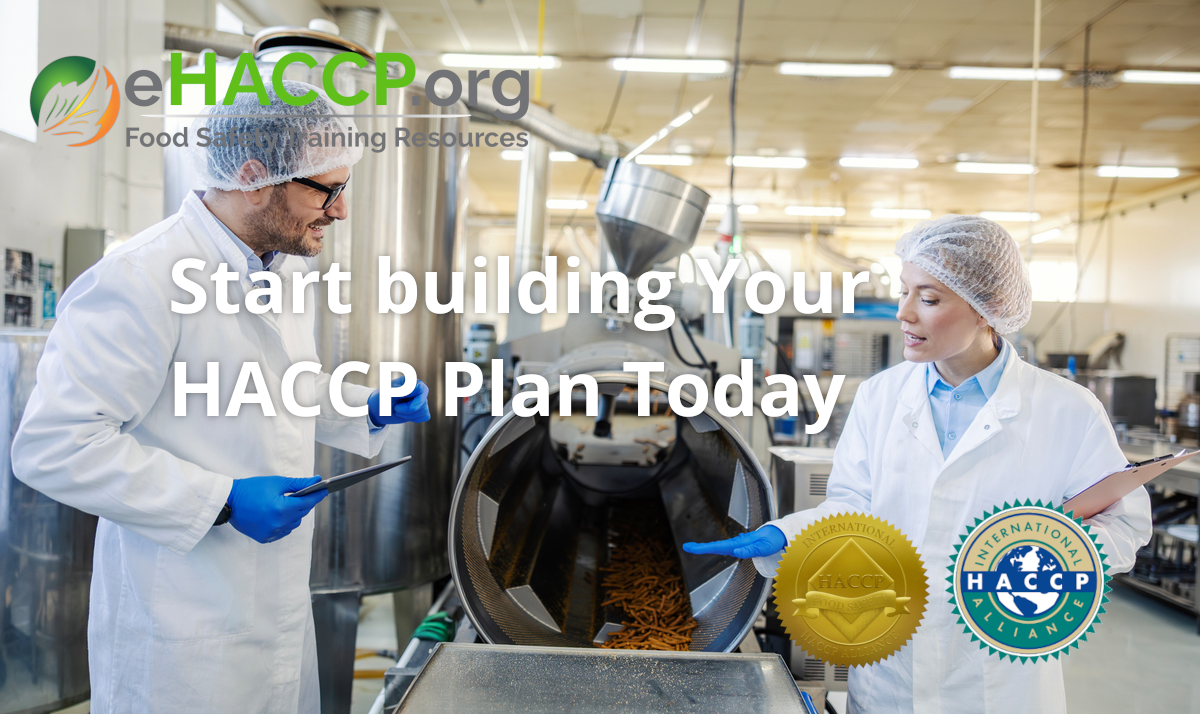

eHACCP.org offers HACCP training that not only offers an IHA accredited Certificate of Completion but effectively teaches the “how-to” build a HACCP plan.
LUNENBURG, NS, CANADA, September 4, 2026 /EINPresswire.com/ — eHACCP.org, a leading online HACCP training and HACCP certification platform, offers a variety of industry specific HACCO courses that teach HACCP plan development.
Most businesses know they need a food safety plan. Some find out after they’ve begun production, by a client or an inspector. Few know where to start, who builds it, how long it takes, what it costs, or who signs off on it.
As a leading IHA-accredited HACCP training and certification platform, eHACCP.org deliver online HACCP and food safety training that is consistent, auditable, cost-effective, and far more practical than hiring a consultant to stare at a blank flowchart. It does more than issue a certificate; it teaches learners how to build the plan from the ground up.
eHACCP.org courses begin with the foundation of HACCP: the history of HACCP, the intersection of HACCP and HARPC under FDA’s FSMA, vulnerable populations, and the four categories of food safety hazards; biological, physical, chemical, and radiological. From there, learners move through the Prerequisite Programs (PRPs) under 21 CFR Part 117, including Current Good Manufacturing Practices (cGMPs):
• Sanitation and cleaning procedures
• Pest control
• Personal hygiene and employee training
• Facility design and maintenance
• Supplier approval and raw material control
• Allergen management
The first five steps of HACCP are covered in detail with real-world scenarios like selecting the right HACCP team, describing the product and its consumer, building the process flow diagram, and validating it on the floor, not just on paper. The next seven steps are the seven principles, taught in logical sequence:
Principle 1 – Hazard Analysis: Identifying every biological, physical, chemical, and radiological risk in the process before a single CCP is named.
Principle 2 – Critical Control Point Identification: A CCP is a specific, measurable step where a targeted control is required to prevent or eliminate a significant food safety hazard, and knowing the difference between a CCP and a general control measure is not optional.
Principle 3 – Establishing Critical Limits: Defining absolute, quantifiable standards, exact time, temperature, pH, and metal detector settings, leaving nothing to interpretation or guesswork.
Principle 4 – Monitoring Procedures: Implementing continuous monitoring, because unforeseen factors can make even the best control measures fail without warning.
Principle 5 – Corrective Actions: Knowing exactly what to do when a critical limit is breached, fix the problem, handle the affected product safely, and documenting it so it never becomes a pattern.
Principle 6 – Verification Procedures: Using tests, reviews, and audits to prove the system works, not just in the binder, but on the line.
Principle 7 – Record-Keeping and Documentation: Maintaining clear, written logs of the hazard analysis, monitoring results, and corrective actions, the evidence that satisfies auditors and regulators before they ask for it.
To support every step, eHACCP.org provides more than 250 downloadable, customizable templates for GMPs, SSOPs, SOPs, logs, charts, and tables. The heavy lifting is already done, learners open, edit, and make it their own. eHACCP.org has a toll free support line for live customer support. The company has a 4.9 star rating with over 1000 reviews.
Stephen Sockett
eHACCP.org
+1 902-343-7763
email us here
Legal Disclaimer:
EIN Presswire provides this news content “as is” without warranty of any kind. We do not accept any responsibility or liability
for the accuracy, content, images, videos, licenses, completeness, legality, or reliability of the information contained in this
article. If you have any complaints or copyright issues related to this article, kindly contact the author above.

Media gallery



