Sports CIOs Face Game-Day Risk as Venue Technology Ownership Remains Fragmented, Finds Info-Tech Research Group
ARLINGTON, Va., Sept. 2, 2026

Press Release Disclaimer: This is a press release distributed through the XPR Media network. It has not been independently verified by our newsroom.

Sports CIOs Face Game-Day Risk as Venue Technology Ownership Remains Fragmented, Finds Info-Tech Research Group
PR Newswire
ARLINGTON, Va., Sept. 2, 2026
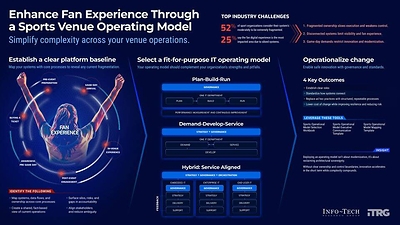
Sports organizations depend on ticketing, mobile apps, access control, point-of-sale systems, sponsorship platforms, and fan data to work together in real time, even when those capabilities are controlled by different teams, venues, leagues, vendors, and partners. Info-Tech Research Group’s Build a Venue Platform Operating Model blueprint helps sports CIOs establish clear control boundaries, decision rights, integration standards, and governance for a more cohesive venue platform.
ARLINGTON, Va., Sept. 2, 2026 /PRNewswire/ — Fans experience a venue as one connected environment, regardless of how many organizations and systems operate behind it. Sports CIOs, however, are often expected to deliver seamless game-day operations while authority over critical systems is distributed across multiple entities. According to Info-Tech Research Group, this mismatch between accountability and authority turns integration into cross-entity negotiation, slows decisions, and creates fragile operations where a system failure can affect revenue, fan experience, and brand reputation.
To help sports organizations replace reactive coordination with a deliberate operating model, the global research and advisory firm has published its Build a Venue Platform Operating Model blueprint. The resource gives CIOs a structured way to map the systems involved and trace how data moves across the fan journey, assess current ownership and control boundaries, and select a model suited to their organization’s operating reality.
“CIOs are accountable for the experience fans have, even when they do not control every system behind it,” says Michael Adams, senior research analyst at Info-Tech Research Group. “That gap between accountability and authority is where delays, inconsistent decisions, and operational fragility take hold. Technology integration can connect the systems. A venue operating model determines who owns the fan relationship, who governs the data, and who has authority to act when a game-day issue demands an immediate decision.”
Key Obstacles Preventing Cohesive Venue Operations
Info-Tech’s blueprint identifies three common obstacles that prevent sports organizations from managing the venue as a unified platform:
- Fragmented ownership and unclear decision rights: Teams, venues, leagues, and partners often optimize their own systems and priorities. Without clearly assigned authority, changes require cross-entity negotiation, causing delays, inconsistent execution, and accountability gaps.
- Disconnected systems and data: Point-to-point integrations and inconsistent data ownership make it difficult and costly to coordinate ticketing, mobile, payments, sponsorship, and other capabilities in real time. Complexity and fragility increase with every new system added.
- Near-zero tolerance for downtime: Game-day operations leave little room for disruption, which can discourage organizations from modernizing critical systems or introducing new capabilities. Continued reliance on legacy technology increases technical debt and long-term operational risk.
Info-Tech’s Three-Phase Approach to Building a Venue Platform Operating Model
The Build a Venue Platform Operating Model blueprint outlines the following methodology for establishing how systems, data, and stakeholders should work together across the venue ecosystem:
Phase 1: Map and assess: Map systems and data across the fan journey, identify who currently controls and operates each capability, and document gaps involving fragmented experiences, disconnected data, unclear ownership, and difficult integrations.
Phase 2: Frame and select: Develop design principles grounded in the organization’s ownership structure, game-day requirements, integration needs, and strategic objectives. Use those principles to evaluate and select the most appropriate operating model.
Phase 3: Govern and operationalize: Define the roles needed to govern the venue platform, assign decision rights and accountability, clarify capability ownership, and prepare executive communications that explain the changes and expected outcomes.
“A strong venue platform can preserve local flexibility while making shared responsibilities explicit,” explains Adams. “Certain capabilities need consistent standards across the enterprise, while others can remain closer to the team or venue. Clear boundaries allow innovation to move forward without relying on informal coordination or compromising game-day reliability.”
The Build a Venue Platform Operating Model blueprint’s supporting resources include a selection tool that enables leaders to evaluate seven operating model archetypes against their design principles, a mapping template for documenting current and future ownership, and an executive communication template for building stakeholder alignment. By applying Info-Tech’s approach, sports organizations can establish clearer accountability, improve coordination across systems and partners, and create a more resilient foundation for connected fan experiences and coordinated venue operations.
For exclusive and timely commentary from Info-Tech’s experts, including Michael Adams, and access to the complete Build a Venue Platform Operating Model blueprint, please contact pr@infotech.com.
About Info-Tech Research Group
Info-Tech Research Group is the “get things done” partner for over 30,000 IT, HR, and marketing leaders worldwide. The fastest growing research and advisory firm, Info-Tech enables leaders to make well-informed decisions and transform their organizations through AI, strategic foresight, step-by-step methodologies, practical tools, industry-leading advisory, and training programs. For nearly 30 years, tens of thousands of private and public organizations have trusted Info-Tech to lead their most important initiatives through periods of change and deliver outcomes that truly matter.
To learn more about Info-Tech’s HR research and advisory services, visit McLean & Company, and for data-driven software buying insights and vendor evaluations, visit the firm’s SoftwareReviews platform.
Media professionals can register for unrestricted access to research across IT, HR, and software, and hundreds of industry analysts through the firm’s Media Insiders program. To gain access, contact pr@infotech.com.
For information about Info-Tech Research Group or to access the latest research, visit infotech.com and connect via LinkedIn and X.

 View original content to download multimedia:https://www.prnewswire.com/news-releases/sports-cios-face-game-day-risk-as-venue-technology-ownership-remains-fragmented-finds-info-tech-research-group-302868195.html
SOURCE Info-Tech Research Group