
America’s Dog Attack Statistics Have a Genetics Problem
New analysis corrects widely circulated fatal dog attack statistics built on breed labels that DNA testing shows are

Press Release Disclaimer: This is a press release distributed through the XPR Media network. It has not been independently verified by our newsroom.
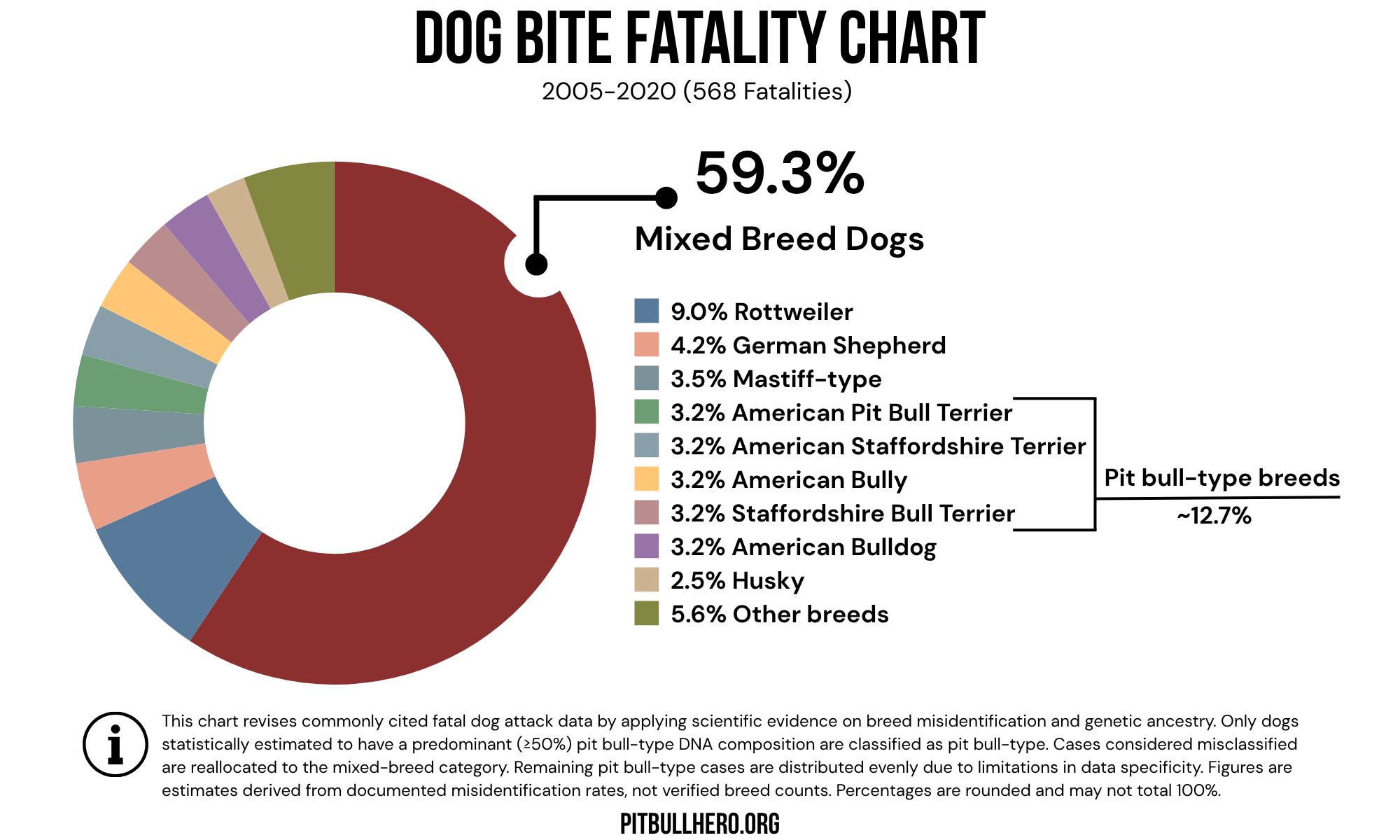

New analysis corrects widely circulated fatal dog attack statistics built on breed labels that DNA testing shows are wrong more often than right
DENVER, CO, UNITED STATES, August 20, 2026 /EINPresswire.com/ — PitbullHero has published a revised set of fatal dog attack statistics, correcting widely circulated figures that rest on unverified breed identifications. Chief among them: the claim that pit bulls cause roughly two-thirds, or 66%, of fatal attacks.
The problem isn’t that the number is slightly off. It’s that nobody ever checked what breed these dogs actually were.
The label that isn’t a breed:
“Pit bull” is not a breed. It’s a visual category spanning at least four breeds: the American Pit Bull Terrier, American Staffordshire Terrier, Staffordshire Bull Terrier, and American Bully, plus an open-ended range of mixes. In practice, it absorbs almost any dog with a blocky head and short coat.
Genetics show how often that guess fails. The Veterinary Journal found 60% of shelter dogs visually identified as pit bulls had no pit bull-type ancestry at all. A PLOS ONE study found that, among dogs that did, 53% carried less than half of their ancestry from pit bull-type breeds, making them mixed breeds by genetic definition, and 98% were mixed-breed overall.
The practical result: a dog that is 62.5% Labrador, 25% Boxer, and 12.5% American Pit Bull Terrier is likely to get recorded as a “pit bull mix” by shelter staff, reporters, and sometimes veterinarians. By its genetics, that dog is a Lab-Boxer mix, even if it has a blocky head and short coat.
Appearance doesn’t track ancestry in proportion. Visual identification reads a handful of surface traits like head shape, coat length, and build, any of which can show up from a minority share of the genome. The label is also asymmetric. A 12.5% pit bull-type share decides how the dog gets recorded, while a 62.5% Labrador share does not. Applied once at intake, the incorrect “pit bull mix” identification follows the dog into news reports, court records, and bite databases.
Comparing a category to a breed:
The flaw compounds from there. Fatality statistics collapse that elastic category into one pit bull line item, then rank it against individual breeds like the German Shepherd. That is the statistical equivalent of comparing accident rates for “trucks” against the Honda CR-V. One will always look worse, and the comparison will never mean anything.
Popularity magnifies the distortion, especially since pit bull-type dogs are among the most popular in the U.S. As the American Veterinary Medical Association has noted, a breed’s bite numbers rise with its population, for reasons unrelated to temperament. It is the same reason best-selling car models top accident statistics.
What the research actually found:
Peer-reviewed studies point away from breed with striking consistency.
– 84% intact: Of dogs involved in fatal attacks, 84% had not been spayed or neutered, per a Journal of the American Veterinary Medical Association study of 256 fatalities. Reproductive status shows up in fatal attacks more consistently than breed does.
– 18% verified: In those same fatalities, breed could be validly determined in only 18% of cases. More than 40% of media breed reports conflicted with animal control’s identification.
– 9% of variation: Breed accounts for only about 9% of the behavioral variation between dogs, per genomic research in the journal Science that sequenced more than 2,000 dogs.
– Bite force: It is a function of body size and skull dimensions, not breed, per research in the Journal of Anatomy.
– No severity gap: The Irish Veterinary Journal found no difference in bite type or medical treatment required between breeds targeted by breed-specific legislation, such as pit bull-type breeds, and comparably strong breeds that aren’t. It also found bites from non-legislated breeds are reported far less often, skewing breed statistics before anyone tabulates them.
A handful of medical studies do reach breed-specific conclusions, and they share the same flaw. None independently verified the breeds in their datasets. They drew on the same unverified breed labels, so their conclusions inherit the same errors.
The incident record points the same way. Since 2016, more than 80 breeds and mixes have been reported in U.S. fatal attacks, including Rottweilers, German Shepherds, Cane Corsos, Huskies, Mastiffs, and Labrador Retrievers. Any large, strong, poorly supervised dog can kill. That is a size-and-circumstance problem, and no breed ban addresses it.
The CDC stopped publishing breed data on fatalities in the early 2000s, citing these identification problems.
What happens when you correct for error:
PitbullHero’s analysis applies the documented error rates to the circulating 66% figure. Remove the cases where DNA research predicts no pit bull-type ancestry, and it falls to roughly 26%. Remove those carrying less than half of their ancestry from pit bull-type breeds, and it falls again to about 13%. That 13% is not one breed: it covers all four breeds commonly grouped under the pit bull-type label, plus their predominant mixes. Reallocating the misidentified dogs to where their genetics place them puts mixed breeds at the top of the corrected list, at nearly 60%.
The point isn’t that 13% is precise. The underlying breed data was never verified, so no exact figure exists in either direction. But taken on its own terms, the corrected figure points in the opposite direction entirely. Based on PitbullHero’s analysis of DNA-testing and veterinary-record data, pit bull-type dogs make up roughly 20% of the U.S. dog population. A group that large appearing in an estimated 13% of fatalities isn’t overrepresented. It’s underrepresented.
Easy to believe, hard to verify:
Sensational statistics travel. They fit in a headline, they might confirm a fear the reader already has, and they feel authoritative precisely because they’re specific. But a statistic is only as good as the data behind it.
The organizations circulating these statistics are not research bodies. Their breed data mostly comes from media reports, social media posts, and visual identifications in police reports, all of which DNA studies have found to be unreliable for breed identification. The expert and veterinary consensus shifted years ago, and most people never heard, because “breed is a poor predictor of behavior” doesn’t trend.
Methodology and sources are available at pitbullhero.org.
Jacob Anderson
PitbullHero
email us here
Visit us on social media:
Facebook
Instagram
X
Legal Disclaimer:
EIN Presswire provides this news content “as is” without warranty of any kind. We do not accept any responsibility or liability
for the accuracy, content, images, videos, licenses, completeness, legality, or reliability of the information contained in this
article. If you have any complaints or copyright issues related to this article, kindly contact the author above.

Media gallery


