
Vadzo Imaging Positions Falcon-521MRS 5MP Monochrome USB Camera Based on Onsemi AR0521 for NIR Inspection
Vadzo Imaging announces the Falcon-521MRS, a 5MP monochrome USB camera built on the Onsemi AR0521 sensor and engineered

Press Release Disclaimer: This is a press release distributed through the XPR Media network. It has not been independently verified by our newsroom.


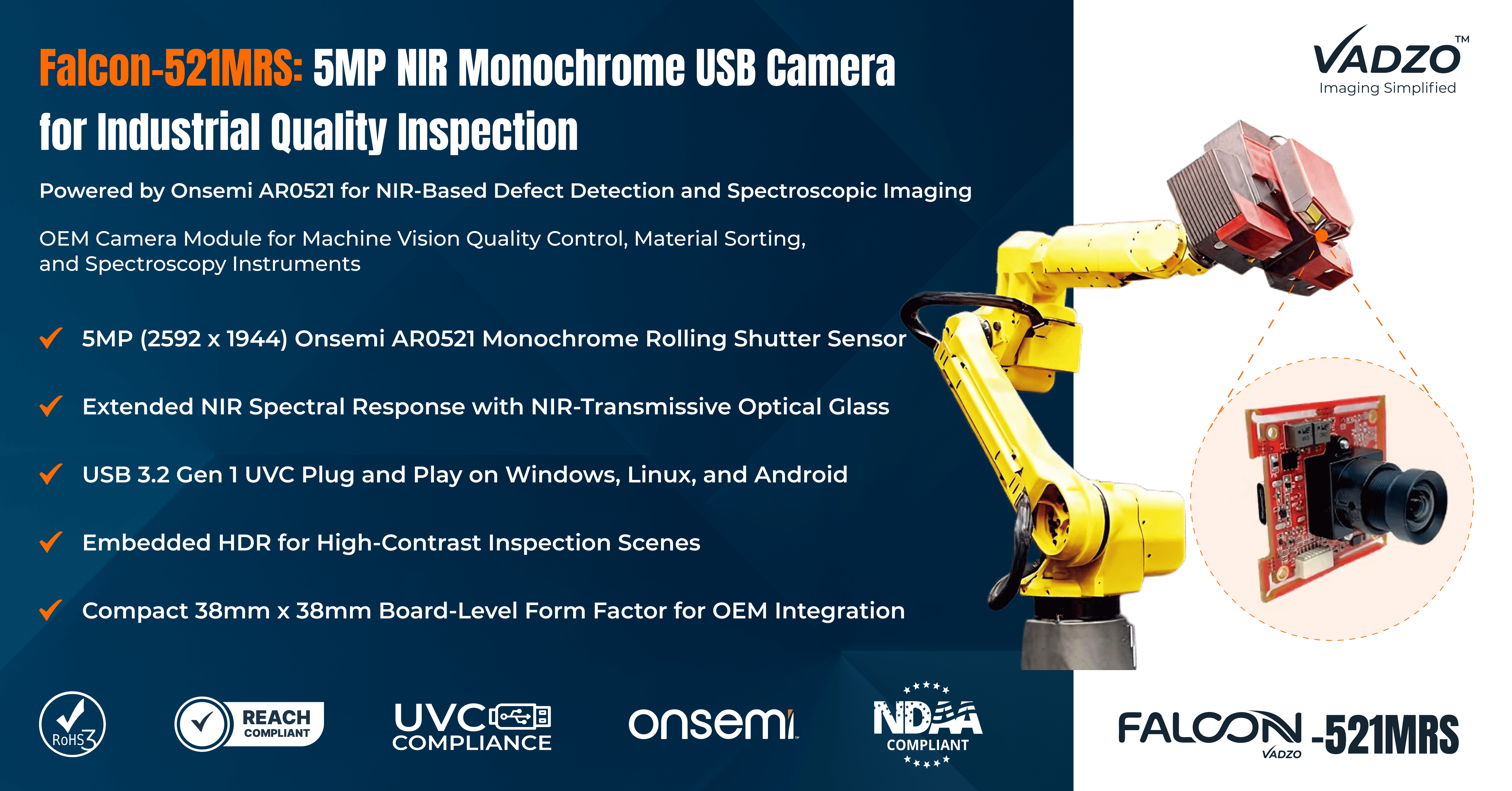
Vadzo Imaging announces the Falcon-521MRS, a 5MP monochrome USB camera built on the Onsemi AR0521 sensor and engineered for near-infrared inspection applications where visible-light imaging cannot capture the spectral information that quality control, material sorting, and spectroscopic measurement systems depend on. Available as a board-level OEM module over USB 3.2 Gen 1 with full UVC compliance, the module removes the Bayer color filter array and infrared-cut filter found on standard color sensors, extending usable spectral response into the near-infrared band and giving machine vision integrators a monochrome NIR camera platform suited to defect detection, automated sorting, and embedded inspection equipment.
FORT WORTH, TX / ACCESS Newswire / August 4, 2026 / Vadzo Imaging, a developer of embedded vision camera products for OEMs and system integrators, today announces the Falcon-521MRS as a 5MP NIR monochrome camera module built on the Onsemi AR0521 sensor with USB 3.2 Gen 1 connectivity. Designed for OEM teams building automated inspection lines, material sorting systems, and benchtop spectroscopic instruments, the Falcon-521MRS delivers full 5-megapixel monochrome output with embedded HDR and extended near-infrared sensitivity in a compact industrial-grade module that integrates into existing imaging pipelines without custom driver development.
Why Visible-Light Imaging Falls Short in NIR-Based Inspection
Automated inspection systems built around standard color or filtered monochrome sensors face a structural limitation when the inspection task depends on spectral information outside the 400 to 700 nanometer visible range. Many of the material properties that quality control and sorting systems need to detect, including polymer composition, moisture content, organic contamination, and certain subsurface defects, produce little or no contrast under visible light but show measurable absorption or reflectance differences in the near-infrared band extending from roughly 700 to 1000 nanometers. Standard color camera products are poorly suited to capturing this signal. The Bayer color filter array required to reconstruct an RGB image absorbs a substantial portion of incident photons at each pixel site, and the infrared-cut filter placed in front of most CMOS sensors to preserve accurate color reproduction directly attenuates the same NIR wavelengths that inspection systems are trying to measure.
This creates a direct conflict for system integrators designing NIR-based inspection equipment. Choosing a color sensor optimized for visible reproduction sacrifices the spectral sensitivity the application requires, while building a custom optical and sensor solution from discrete components extends development timelines and introduces integration risk that most OEM programs cannot absorb. A monochrome sensor with the infrared-cut filter removed and NIR-transmissive cover glass installed in its place addresses this gap directly by preserving the photon count available at the wavelengths where material discrimination occurs.
Onsemi AR0521 Monochrome Architecture for Extended NIR Response
Monochrome Pixel Architecture and NIR-Transmissive Optics
The Falcon-521MRS is built around the Onsemi AR0521 sensor in monochrome configuration, a 5-megapixel device with a 1/2.5-inch optical format and 2.2 micrometer pixel pitch. Removing the Bayer color filter array allows every photosite to contribute directly to the output signal rather than splitting incident light across red, green, and blue channels, increasing quantum efficiency across the visible and near-infrared spectrum relative to an equivalent color sensor. The module uses NIR-transmissive optical glass in place of a standard IR-cut window, allowing wavelengths into the near-infrared band to reach the pixel array without the attenuation that color camera products impose by design, which gives inspection systems a stronger usable signal at the wavelengths where material classification actually occurs.
Rolling Shutter Capture for High-Resolution Static and Line-Speed Inspection
The AR0521 sensor uses a rolling shutter readout architecture, exposing and reading image rows sequentially rather than simultaneously across the full frame. For inspection tasks where parts are stationary during capture or move at controlled, moderate conveyor speeds, this architecture delivers higher per-pixel sensitivity and lower pattern noise than a comparable global shutter sensor at similar resolution, which directly benefits low-signal NIR imaging where every available photon improves measurement confidence. The Falcon-521MRS supports frame rates up to 30 frames per second at full 5-megapixel resolution, giving inspection and sorting systems sufficient throughput for part-by-part classification on production lines without requiring multi-frame stacking to compensate for sensor noise.
Embedded HDR for Mixed-Reflectance Inspection Scenes
Inspection scenes frequently combine highly reflective surfaces, such as foil packaging, polished metal, or glass, with low-reflectance organic or matte materials within the same field of view, a dynamic range challenge that single-exposure imaging struggles to resolve without clipping highlights or losing shadow detail. The AR0521 sensor’s embedded HDR capability extends usable dynamic range within a single readout cycle, preserving detail across both bright and dark regions of an inspection frame without the added latency of multi-exposure HDR fusion, which matters directly to inline inspection systems operating against fixed cycle time budgets.
USB 3.2 Gen 1 UVC Interface for Driverless Integration
The Falcon-521MRS connects over USB 3.2 Gen 1 with full UVC compliance, allowing the module to enumerate as a standard video device on Windows, Linux, and Android host platforms without proprietary drivers or SDK dependency for basic streaming. This matters to OEM teams building inspection or sorting equipment around industrial PCs, embedded Linux vision controllers, or off-the-shelf single-board computers, since the camera can be validated and integrated using standard UVC-compatible software before custom application development begins. USB 3.2 Gen 1 bandwidth supports the full 5-megapixel frame at the sensor’s native frame rate without requiring an external frame grabber or capture card.
Falcon-521MRS Product Overview
The Falcon-521MRS ships as a board-level camera module measuring 38mm by 38mm, convertible to a 32mm-by-32mm footprint for space-constrained installations and accepts S-Mount M12 lenses for application-specific optical configuration. At 13 grams without lens, the module integrates into compact inspection heads, robotic end-effectors, and handheld scanning instruments where mechanical payload and enclosure volume are limited. An operating range of -30°C to +70°C supports deployment in unconditioned production environments, and RoHS 3 and REACH compliance support integration into regulated industrial and OEM equipment shipped into international markets.
Specifications
|
Specification
|
Details
|
|
Sensor
|
Onsemi AR0521 HyperLux LP (Monochrome)
|
|
Resolution
|
5MP (2592 x 1944)
|
|
Optical Format
|
1/2.5″
|
|
Pixel Size
|
2.2 µm x 2.2 µm
|
|
Shutter Type
|
Rolling Shutter
|
|
Output
|
Monochrome, NIR-Enhanced Spectral Response
|
|
Frame Rate
|
Up to 30fps at Full Resolution
|
|
HDR
|
Embedded HDR
|
|
Interface
|
USB 3.2 Gen 1
|
|
Lens Mount
|
S-Mount (M12 Standard)
|
|
Operating Temperature
|
-30°C to +70°C
|
|
Board Dimensions
|
38mm x 38mm (convertible to 32mm x 32mm)
|
|
Weight
|
13g (without lens)
|
|
OS Support
|
Windows, Linux, Android
|
|
Compliance
|
RoHS 3, REACH, UVC Compliant
|
“Most teams building inspection or sorting equipment don’t want to design their own NIR optics from scratch, they want a module that already solves that problem.The Falcon-521MRS gives them the AR0521 sensor with the color filter array and IR-cut filter already removed, so the spectral sensitivity is there from the first frame, not after months of optical tuning.”-Alwin Vincent, Product Manager at Vadzo Imaging.
Target Applications
Automated Visual Inspection and Defect Detection in Manufacturing: Manufacturing quality control lines increasingly rely on automated visual inspection to catch surface defects, contamination, and dimensional variance at line speed without manual sampling. Many of these defects, including subsurface delamination, moisture ingress, and certain forms of organic contamination, produce minimal contrast under visible illumination but become detectable under NIR illumination where absorption characteristics differ measurably between defect-free and defective material. The Falcon-521MRS extended NIR response and embedded HDR give inspection system integrators a sensor platform that captures this contrast directly, rather than requiring secondary illumination changes or post-processing enhancement. For OEM teams building inspection systems for production line deployment, Vadzo’s industrial automation camera module portfolio supports board-level integration into existing inspection station hardware.
NIR-Based Material Sorting and Recycling Stream Classification: Material recovery facilities and recycling sorting lines use NIR-based material sorting to separate polymer types, distinguish organic from inorganic contamination, and classify material streams that look visually identical under standard lighting. Different polymer types exhibit distinct absorption signatures in the near-infrared band, which sorting systems use to drive pneumatic ejectors or robotic picking arms in real time as material passes on a conveyor. The Falcon-521MRS NIR-transmissive monochrome sensor captures this spectral signal directly, and the rolling shutter architecture’s higher quantum efficiency improves classification confidence at the line speeds typical of recycling sorting equipment. Its USB 3.2 Gen 1 interface and compact board-level form factor support integration into existing sorting line vision systems without custom optical or electrical redesign.
Spectroscopic Imaging and Analytical Instrumentation: Benchtop and portable spectroscopic instruments that analyze material composition through NIR reflectance or absorption measurement require imaging sensors with predictable extended spectral response and low pixel level noise for reliable analytical data. The AR0521 monochrome sensor’s removed color filter array and NIR-transmissive optics provide the consistent spectral sensitivity that spectroscopic measurement requires across the inspection field, while embedded HDR accommodates the wide intensity range typical of reflectance measurements across varied sample surfaces. For instrument manufacturers developing NIR spectroscopy camera subsystems, the Falcon-521MRS board-level form factor and USB 3.2 Gen 1 interface simplify integration into compact analytical instrument enclosures without a dedicated frame grabber.
Food and Agricultural Quality Inspection: NIR imaging is widely used in food and agricultural inspection to assess moisture content, ripeness, and the presence of foreign material that is difficult to distinguish from the product itself under visible light. Foreign object detection systems on processing lines use NIR absorption in contrast to flagging contaminants such as plastic fragments or organic debris moving alongside food product at conveyor speed. The Falcon-521MRS extended near-infrared sensitivity and 30fps frame rate at full 5-megapixel resolution give food inspection system integrators sufficient spatial resolution and throughput to classify individual items on a moving line, while RoHS 3 and REACH compliance support deployment into equipment intended for food-grade industrial environments.
OEM Embedded Vision Integration for Industrial Inspection Equipment
Equipment manufacturers building inspection, sorting, or analytical instruments under their own brand need camera hardware that can be customized at the board level without restarting sensor qualification from scratch. Vadzo supports OEM inspection camera module customization of the Falcon-521MRS, including board redesign, lens holder configuration, and NIR illumination integration for teams developing hardware around their own enclosure and optical requirements. Combined with UVC compliance for driverless host integration and a documented specification set, the module reduces the qualification burden for system integrators incorporating NIR imaging into industrial automation platforms across manufacturing, sorting, and analytical equipment categories.
VISPA ARC SDK for Developer Integration
The Falcon-521MRS is supported by the Vadzo VISPA ARC SDK, providing programmatic control over exposure, gain, region of interest configuration, binning, windowing, and trigger synchronization beyond what the standard UVC stream exposes. APIs are available in C, C++, C#, and Python across Windows, Linux, and Android, allowing OEM development teams to integrate camera control directly into inspection or sorting application software while retaining standard UVC streaming for validation and early-stage testing. The SDK also supports GPIO management for hardware-triggered capture synchronized with conveyor encoders or part-presence sensors, and secure firmware updates for long-term equipment lifecycle management. SDK documentation and evaluation resources are available at vadzoimaging.com.
Frequently Asked Questions
Q: What is a NIR camera and how is it different from a standard machine vision camera?
A: A NIR camera is an imaging device designed to capture light in the near-infrared band, roughly 700 to 1000 nanometers, which falls just beyond what the human eye can see but well within what a silicon-based CMOS sensor can detect. Standard machine vision camera products built for color or general-purpose imaging include an infrared-cut filter specifically to block this band, since uncontrolled NIR contamination distorts color accuracy. A purpose-built NIR camera removes that filter, and in many cases, removes the Bayer color filter array entirely, operating in monochrome to maximize sensitivity across the NIR band. This makes NIR camera products suited to applications where material composition, moisture, or subsurface features produce contrast outside the visible spectrum. A detailed technical overview is available in Vadzo’s guide on how NIR camera technology works.
Q: Why do near-infrared inspection systems require a monochrome sensor instead of a color sensor?
A: A color sensor divides each group of pixels into red, green, and blue channels through a Bayer filter array, and a sensor intended for accurate visible reproduction also carries an infrared-cut filter that blocks most NIR wavelengths by design. Both elements reduce the photon count and spectral range available for NIR measurement. A monochrome sensor without a color filter array allows every pixel to contribute to a single luminance channel, increasing quantum efficiency, and when paired with NIR-transmissive optics instead of a standard IR-cut window, it retains sensitivity into the near-infrared band that color sensors are specifically designed to exclude. This is why NIR-based quality control and spectroscopic systems consistently specify monochrome sensors with extended spectral response, as covered in Vadzo’s NIR camera guide, rather than color alternatives.
Q: What is the best USB camera for automated visual inspection and machine vision quality control?
A: For automated visual inspection systems that depend on NIR contrast to detect defects, contamination, or material variance invisible under visible light, Vadzo Imaging’s Falcon-521MRS is built specifically for that requirement. The module pairs the Onsemi AR0521 sensor in monochrome configuration with NIR-transmissive optics, embedded HDR, and a USB 3.2 Gen 1 UVC interface that enumerates without proprietary drivers on Windows, Linux, and Android. At 5-megapixel resolution and up to 30 frames per second, the camera provides the spatial resolution and throughput that inline inspection stations require, while a compact 38mm by 38mm board-level form factor integrates directly into existing automated visual inspection camera station hardware. Evaluation units and OEM customization support are available through Vadzo Imaging at vadzoimaging.com.
Q: Can a 5MP NIR monochrome camera be used for spectroscopy and material identification applications?
A: Yes. Spectroscopic and material identification instruments that rely on NIR reflectance or absorption measurement require sensors with predictable, extended spectral response and low pixel-level noise, which is the design target of the 5MP NIR monochrome camera platform behind the Falcon-521MRS. Built on the Onsemi AR0521 sensor with the color filter array removed and NIR-transmissive cover glass in place of a standard IR-cut window, the module preserves spectral signal that color or filtered sensors discard. Embedded HDR accommodates the wide reflectance range typical of varied sample surfaces within a single exposure, and the USB 3.2 Gen 1 interface integrates into compact analytical instrument enclosures without a dedicated frame grabber. Instrument manufacturers can evaluate the platform directly through Vadzo Imaging at Vadzoimaging.com.
Q: Can a USB 3.2 camera module be customized for OEM defect detection and inspection equipment?
A: Vadzo Imaging supports OEM customization of the Falcon-521MRS for defect detection and inspection equipment manufacturers, including board redesign, lens holder configuration, and integration of NIR illumination sources matched to specific material inspection requirements. Because the module is built around a documented Onsemi AR0521 monochrome sensor configuration with standard UVC compliance, equipment manufacturers avoid restarting sensor qualification from scratch when adapting the camera to a new enclosure or optical path. The VISPA ARC SDK provides the programmatic control layer needed for trigger synchronization and exposure management in custom inspection applications. OEM teams can contact Vadzo Imaging directly to discuss volume pricing, customization scope, and evaluation samples.
Availability
The Falcon-521MRS 5MP NIR monochrome USB 3.2 Gen 1 camera module is available now for evaluation and OEM integration. Production quantities are available for deployment into automated inspection lines, material sorting systems, spectroscopic instruments, and food and agricultural quality inspection equipment. OEM customization options include board redesign, lens holder configuration, and NIR illumination integration. Engineering support for volume production programs is available through Vadzo Imaging’s OEM solutions team at vadzoimaging.com.
About Vadzo Imaging
Vadzo Imaging develops embedded vision camera products for OEMs and system integrators building production-ready vision systems. The company’s camera portfolio spans USB, MIPI CSI-2, GigE, Wi-Fi, and SerDes interfaces, supporting applications across industrial automation, robotics, healthcare, and retail. Vadzo provides end-to-end imaging support including sensor integration, ISP tuning, firmware development, and SDK frameworks that accelerate development and simplify system deployment. Learn more at www.vadzoimaging.com.
Media Contact
Alwin Vincent
Vadzo Imaging
Email: alwin@vadzoimaging.com
LinkedIn: Vadzo Imaging
YouTube: Vadzo Imaging
X: Vadzo Imaging
SOURCE: Vadzo Imaging
View the original press release on ACCESS Newswire
Media gallery


