
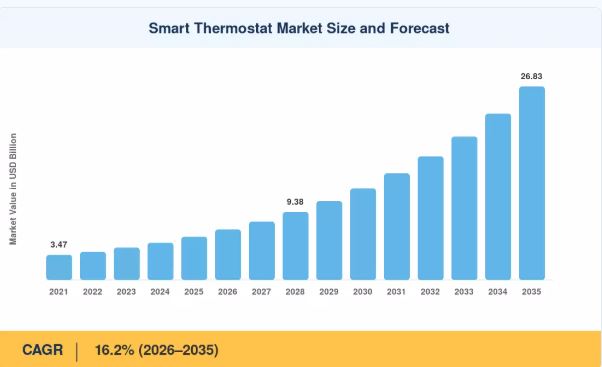
Smart Thermostat Market to Grow from USD 5.98 Billion in 2025 to USD 26.83 Billion by 2035 at 16.2% CAGR
Smart Thermostat Market Size, Share and Research Report By Connectivity Technology (Wi-Fi, Zigbee, Z-Wave, Thread,

Press Release Disclaimer: This is a press release distributed through the XPR Media network. It has not been independently verified by our newsroom.

Smart Thermostat Market Size, Share and Research Report By Connectivity Technology (Wi-Fi, Zigbee, Z-Wave, Thread, Bluetooth / Other), By Installation Type
NEW YORK,, NY, UNITED STATES, July 30, 2026 /EINPresswire.com/ — The Global Smart Thermostat market reached an estimated USD 5.98 billion in 2025 and is projected to grow from USD 6.95 billion in 2026 to USD 26.83 billion by 2035, registering a CAGR of 16.2% during the forecast period. Two forces are accelerating adoption faster than most building-technology categories: tightening energy-efficiency mandates at the federal and municipal level, and the rollout of the Matter interoperability standard, which has eliminated the ecosystem lock-in that kept cautious buyers on the sideline for years.
Utility incentive programs in the United States alone disbursed over USD 320 million in smart thermostat rebates in 2024, creating a direct pull-through channel that bypasses traditional retail friction, while government energy-efficiency mandates (~22–26% CAGR impact), utility demand-response and rebate programs (~18–22%), and Matter/Thread interoperability adoption (~14–17%) stand out as the highest-impact growth drivers.
The technology shift underway is replacing decades-old programmable thermostats devices that fewer than 40% of homeowners ever programmed correctly with AI-optimized units that learn occupancy patterns, integrate weather-forecast data, and adjust HVAC cycles autonomously. Hardware costs have dropped roughly 18% since 2021 thanks to the commoditization of dual-band Wi-Fi/Thread chips and lower-cost ambient sensors, while manufacturers increasingly compete on software features and subscription energy-reporting dashboards rather than on device price alone.
North America commands roughly 42% of the Smart Thermostat Market, underpinned by high HVAC penetration and mature utility demand-response infrastructure. Asia-Pacific is the fastest-growing region at a projected 19.2% CAGR through 2035, driven by urbanization in China and India and new green-building codes in South Korea and Japan, while Europe holds the second-largest share at approximately 25%, where the EU Energy Performance of Buildings Directive is pushing retrofit activity across the continent’s aging housing stock. As grid operators globally begin enrolling connected thermostats into virtual power plants, the installed base is evolving from a consumer convenience product into a distributed energy asset with system-level value.
Get Full PDF Sample Copy of Report: (Including Full TOC, List of Tables & Figures, Chart) @
https://www.marketresearchfuture.com/sample_request/2521
➤ How Significant Is the Smart Thermostat Market’s Growth?
The smart thermostat market’s trajectory from USD 5.98 billion in 2025 to a projected USD 26.83 billion by 2035 represents nearly a four-and-a-half-fold expansion over the forecast decade, reflecting the structural shift from manually programmed devices toward AI-optimized, grid-integrated controls as a mainstream fixture of residential and commercial buildings. The market’s 16.2% CAGR is anchored in a policy-and-utility supercycle where energy-efficiency mandates, demand-response rebates, and interoperability standards are converging to pull connected thermostats out of the early-adopter niche and into standard building specification.
Wi-Fi-enabled devices dominated with approximately 69% of 2024 revenue, reflecting the protocol’s ubiquity in residential broadband networks, while Thread-based connectivity is forecast to expand at a 19.3% CAGR through 2035, aided by the Matter standard’s native support for Thread mesh networking. Retrofit installations captured roughly 62% of 2024 market share as homeowners upgraded existing HVAC systems without full renovation, and learning thermostats accounted for approximately 48% of the market in 2024, outpacing programmable-only and app-controlled models. The residential segment represented about 76% of 2024 revenue, though commercial deployments are accelerating through portfolio-wide building-management platforms, and North America led with a 42% share of the market in 2024 while Asia-Pacific is positioned for the highest growth trajectory over the forecast period.
➤ What Does the Future Hold for the Smart Thermostat Market?
Government energy-efficiency mandates are the single most durable tailwind for the smart thermostat market. The U.S. Inflation Reduction Act allocated USD 8.8 billion to residential efficiency programs through 2032, with connected thermostat rebates explicitly qualifying under the HOMES Act provisions. In the EU, the recast Energy Performance of Buildings Directive requires all new residential buildings to be zero-emission by 2028 and mandates smart-ready indicators on building energy certificates, while Japan’s revised Building Energy Efficiency Act, effective April 2025, extends mandatory efficiency reporting to mid-sized commercial buildings.
Utility demand-response and rebate programs are treating connected thermostats as grid-balancing assets. Southern California Edison’s Summer Discount Plan enrolled over 1.2 million smart thermostats in 2024, compensating participants with bill credits of USD 50–75 per cooling season while reducing peak load by an estimated 600 MW on critical-demand days. Matter and Thread interoperability standards add a further growth vector: before Matter 1.0 shipped in late 2022, consumers faced hard choices between Alexa, HomeKit, and Google Home ecosystems, and by mid-2025, over 85% of new smart thermostat SKUs shipped with Matter certification. Meanwhile, declining sensor and chip costs the average bill-of-materials for a Wi-Fi/Thread dual-band connected thermostat fell from USD 38 in 2021 to roughly USD 26 in 2025 have enabled OEMs to introduce sub-USD-100 retail devices without sacrificing margin.
By 2030, on-device AI co-processors will enable thermostats to run reinforcement-learning models locally, eliminating cloud-latency penalties and addressing data-residency concerns that have slowed adoption in privacy-sensitive European markets. The IEA projects that AI-optimized building controls could reduce global building energy consumption by 10% by 2035, translating to roughly USD 150 billion in avoided energy costs, while the global heat-pump installed base is expected to reach 600 million units by 2035 every installation representing a natural attach opportunity for a smart thermostat capable of managing variable-speed compressors and defrost cycles.
Get access to the full description of the report @
https://www.marketresearchfuture.com/reports/smart-thermostat-market-2521
➤ Who Are the Key Players in the Smart Thermostat Market?
The smart thermostat market exhibits medium concentration, with the top five players accounting for an estimated 55–62% of global revenue. The competitive dynamic is shifting from hardware differentiation toward software, services, and ecosystem integration; smaller specialists compete effectively in commercial niches, but the consumer segment is increasingly consolidated around brands with built-in voice-assistant ecosystems and retail shelf space. MRFR identifies the following key participants with estimated revenue share ranges:
Google / Nest (~18–22% share) – the ecosystem integration leader with the Nest Learning Thermostat and Nest Thermostat, leveraging deep ties to Google Home and Assistant to anchor the premium consumer segment.
Honeywell Home / Resideo (~12–16% share) – the broadest HVAC contractor distribution network in the industry, offering the T-Series, Lyric, and Round product lines across pro-install and retail channels.
ecobee (~8–12% share) – a built-in Alexa and room-sensor ecosystem specialist with the Smart Thermostat Premium and Enhanced lines, differentiated by multi-room comfort sensing.
Emerson / Sensi (~6–9% share) – a pro-channel focused provider with the Sensi Touch 2 and Sensi Lite, built around a dedicated contractor app for installation and service.
Johnson Controls (~5–8% share) – a commercial building-management platform integrator offering GLAS and OpenBlue connected controls for portfolio-wide HVAC optimization.
Schneider Electric (~4–7% share) – a European residential and commercial specialist with the Wiser smart thermostat range, increasingly bundled with solar-PV and home-battery scheduling.
Carrier Global (~3–6% share) – an OEM bundling specialist offering Côr and Infinity System Control thermostats packaged with Carrier HVAC equipment.
Trane Technologies (~3–5% share) – a premium HVAC system integration provider with Trane ComfortLink and XL series thermostats designed for tight coupling with Trane equipment.
Siemens (~2–4% share) – a commercial and industrial building automation specialist offering Smart Thermostat RDS and Climatix controls.
Lux Products (~1–3% share) – a value-segment and mass-retail channel provider with the Kono Smart and GEO thermostat lines targeting budget-conscious buyers.
Strategic competition in the smart thermostat market is increasingly defined by software and subscription-service depth, Matter/Thread certification breadth, utility and demand-response program integrations, and the pace at which vendors can shift from hardware-margin to platform-economics business models.
➤ What Are the Emerging Trends in the Smart Thermostat Market?
Several transformational trends are redefining the smart thermostat market’s evolution through 2035:
AI-Driven Autonomous HVAC Orchestration: On-device AI co-processors are enabling thermostats to run reinforcement-learning models locally, eliminating cloud-latency penalties and addressing data-residency concerns in privacy-sensitive markets, with the IEA projecting AI-optimized building controls could cut global building energy consumption by 10% by 2035.
Platform Economics and Subscription Revenue: The market is shifting from a hardware-margin business to a platform-economics model, with OEMs launching tiered subscription plans energy-insight dashboards, predictive-maintenance alerts, and home-insurance discounts generating recurring revenue at 60–70% gross margins.
Electrification and Heat-Pump Integration: The global heat-pump installed base is expected to reach 600 million units by 2035, with each installation representing a natural attach opportunity for smart thermostats capable of managing variable-speed compressors and defrost cycles that basic programmable devices cannot handle.
ESG Reporting and Carbon-Accounting Integration: As mandatory corporate ESG disclosure frameworks expand, commercial tenants and landlords increasingly need granular, auditable energy data repositioning smart thermostats from operational tools to compliance infrastructure and expanding the buyer set to CFOs and sustainability officers.
Virtual Power Plant Enrollment and Grid-Services Revenue: Utilities are prepared to pay USD 20–40 per enrolled thermostat per year for the right to orchestrate brief setback events during peak demand windows, with the global installed base projected to exceed 180 million connected thermostats by 2030.
Commercial Building Portfolio Platforms: Property managers operating hundreds of retail, office, or hospitality sites are adopting cloud-native fleet-management platforms that optimize HVAC schedules across time zones and occupancy profiles, creating high-margin SaaS revenue streams and deep customer lock-in.
Buy Full Research Report:
https://www.marketresearchfuture.com/checkout?currency=one_user-USD&report_id=2521
➤ How Is the Smart Thermostat Market Segmented?
The smart thermostat market report provides a comprehensive segmentation framework:
By Connectivity Technology: Wi-Fi (69% share, 2024), Zigbee (USD 0.52 Billion, 2025), Z-Wave (7.2% share, 2024), Thread (19.3% CAGR), Bluetooth / Other (USD 0.18 Billion, 2025)
By Installation Type: Retrofit (62% share, 2024), New Construction (18.5% CAGR)
By Product Intelligence Level: Learning Smart Thermostats (48% share, 2024), Connected/Programmable (USD 1.89 Billion, 2025), Stand-Alone / App-Only (17.8% CAGR)
By End User: Residential (76% share, 2024), Commercial (17.4% CAGR), Industrial / Other (USD 0.14 Billion, 2025)
By Region: North America (42% share, 2024), Europe (USD 1.49 Billion, 2025), Asia-Pacific (19.2% CAGR), South America (USD 0.42 Billion, 2025), Middle East & Africa (17.1% CAGR)
➤ What Are the Regional Insights from the Smart Thermostat Market?
North America leads the smart thermostat market with a 42% share in 2024, with the United States accounting for 78% of regional revenue as ENERGY STAR-certified thermostat shipments exceeded 12 million units in 2024. Federal tax credits of up to USD 150 per device under the IRA have stacked on top of state-level utility rebates, effectively halving the cost of ownership for qualifying households, while Canada’s Greener Homes Grant program offsets up to CAD 5,000 for home efficiency upgrades that include smart thermostat installation, and Mexico is growing at a 15.8% CAGR on rising middle-class housing construction.
Europe holds the second-largest share at approximately 25% of global revenue, with its trajectory shaped by the EU’s Energy Performance of Buildings Directive recast, which enters enforcement in 2027 and requires member states to establish minimum energy-performance standards for existing buildings, triggering a continent-wide retrofit cycle. Germany commands roughly 22% of regional revenue through its Energiewende building retrofit wave and has earmarked EUR 18.6 billion for building-efficiency loans through 2028, while the UK, France, Italy, Spain, and the Nordic countries contribute through the Boiler Upgrade Scheme, MaPrimeRénov’ incentives, Superbonus transition credits, Mediterranean cooling demand, and district heating integration respectively.
Asia-Pacific is the fastest-growing region at a 19.2% CAGR, with China commanding approximately 35% of regional revenue through government smart-city procurement programs tied to its 14th Five-Year Plan for Building Energy Conservation, which targets a 25% reduction in building energy intensity by 2030. India is expanding at a 19.8% CAGR through the ECBC 2024 commercial building mandates and its Smart Cities Mission Phase III, which is allocating INR 48,000 crore toward intelligent building infrastructure across 100 cities, while Japan, South Korea, and ASEAN contribute through the Building Energy Efficiency Act expansion, Green New Deal zero-energy targets, and rapid urbanization respectively.
South America and the Middle East & Africa represent smaller but structurally growing shares of global revenue. Brazil commands 52% of South American revenue as its PROCEL efficiency labeling program expanded to include connected HVAC controls in 2024, with Argentina growing at a 14.2% CAGR as energy-subsidy reform sharpens the value proposition of thermostat-based energy management. In the Middle East & Africa, extreme cooling demand air conditioning accounts for over 70% of peak electricity load in Gulf Cooperation Council states makes the market a strategic priority for grid planners, with Saudi Arabia holding 24% of regional revenue through Vision 2030 smart-building mandates and the UAE growing at a 16.8% CAGR as Dubai’s Green Building Code and DEWA’s Shams Dubai program drive adoption.
➤➤➤ Regional & Country-Level Reports by Market Research Future:
US Smart Thermostat Market –
https://www.marketresearchfuture.com/reports/us-smart-thermostat-market-18138
➤➤➤Related Reports by Market Research Future:
Spatial Light Modulator Market
https://www.marketresearchfuture.com/reports/spatial-light-modulator-market-1721
Emergency Lighting Market
https://www.marketresearchfuture.com/reports/emergency-lighting-market-3866
Smart Street Lights Market
https://www.marketresearchfuture.com/reports/smart-street-lights-market-5966
Micro-Led Display Market
https://www.marketresearchfuture.com/reports/micro-led-display-market-6973
Oled Microdisplay Market
https://www.marketresearchfuture.com/reports/oled-microdisplay-market-7479
As-Interface Market
https://www.marketresearchfuture.com/reports/actuator-sensor-interface-market-3820
Household Robot Market
https://www.marketresearchfuture.com/reports/household-robot-market-8196
Kids Tablet Market
https://www.marketresearchfuture.com/reports/kids-tablet-market-8338
Oil & Gas Scada Market
https://www.marketresearchfuture.com/reports/oil-gas-scada-market-7925
Industrial Robotics Market
https://www.marketresearchfuture.com/reports/industrial-robotics-market-1933
Portable Battery Market
https://www.marketresearchfuture.com/reports/portable-battery-market-941
Sagar Kadam
Market Research Future
+ + +1 628-258-0071
email us here
Legal Disclaimer:
EIN Presswire provides this news content “as is” without warranty of any kind. We do not accept any responsibility or liability
for the accuracy, content, images, videos, licenses, completeness, legality, or reliability of the information contained in this
article. If you have any complaints or copyright issues related to this article, kindly contact the author above.

Media gallery

