Water Softening Systems Market to Reach USD 6.41 Billion by 2035 at 7.2% CAGR
The global Water Softening Systems Market reached an estimated USD 3.20 billion in 2025 and is projected to grow from

Press Release Disclaimer: This is a press release distributed through the XPR Media network. It has not been independently verified by our newsroom.
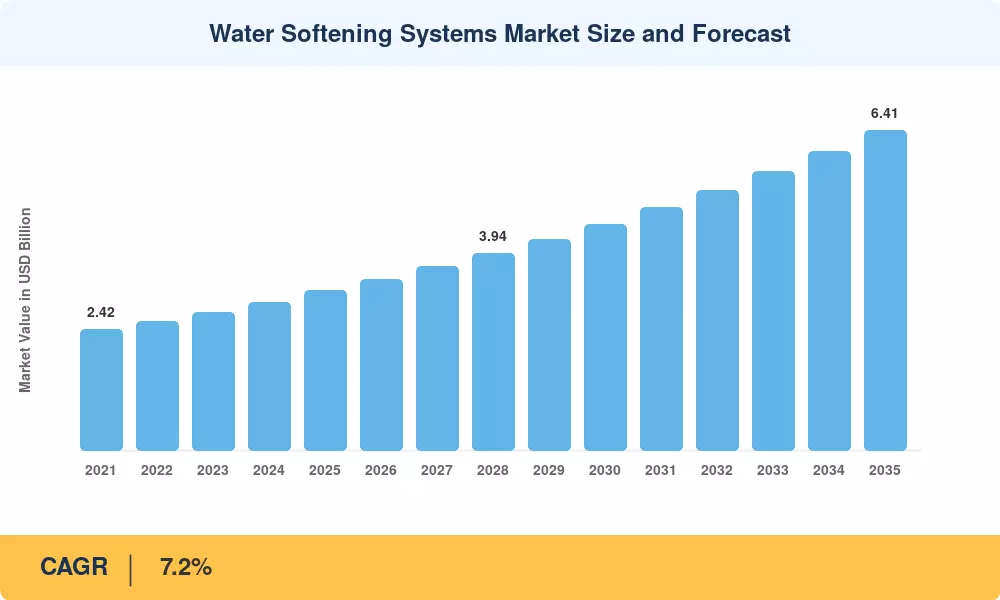

The global Water Softening Systems Market reached an estimated USD 3.20 billion in 2025 and is projected to grow from USD 3.43 billion in 2026
NEW YORK, NY, UNITED STATES, July 29, 2026 /EINPresswire.com/ — The global Water Softening Systems Market reached an estimated USD 3.20 billion in 2025 and is projected to grow from USD 3.43 billion in 2026 to USD 6.41 billion by 2035, registering a CAGR of 7.2% during the forecast period (2026–2035).
Market Overview
Water softening systems are specialized water treatment solutions designed to remove hardness-causing minerals—primarily calcium and magnesium ions—from water through various physical and chemical processes. These systems protect plumbing infrastructure, enhance the efficiency and lifespan of water-using appliances, and improve the effectiveness of soaps and detergents. The market encompasses diverse technologies including traditional ion exchange systems, salt-free conditioning units, reverse osmosis hybrids, and magnetic/electronic descalers, serving a wide range of residential, commercial, and industrial applications. Each technology offers distinct advantages in terms of effectiveness, maintenance requirements, environmental impact, and cost, catering to different water quality challenges and user preferences.
Two catalysts stand out: tightening drinking water quality regulations across the U.S. EPA and European DWD recast frameworks, and the accelerating replacement cycle for aging municipal water infrastructure — a pipeline the American Water Works Association values at over USD 1 trillion through 2040. Together, these forces are pulling residential, commercial, and industrial buyers toward advanced water treatment at a pace the industry hasn’t seen in over a decade.
Legacy single-tank timer-based softeners are being replaced by digitally controlled, metered-on-demand machines that reduce salt use by 30–40% and water waste by up to 50%. Meanwhile, template-assisted crystallization and catalytic media technologies are establishing themselves in niches where brine discharge rules restrict conventional salt-based systems. Since 2023, California and other EU member states have adopted or imposed stricter discharge limitations. The Water Softening Systems market is transitioning from a commoditized replacement growth cycle to a technology-differentiated growth cycle.
Industry trends indicate a decisive shift toward smart, connected, and sustainable solutions. Connected softeners — units that monitor real-time water usage, predict regeneration timing, and alert owners via smartphone apps — have grown from under 5% of residential unit sales in 2020 to roughly 18% in 2024. This digitalization trend raises average selling prices by 25–35% per unit. Salt-free conditioning technologies are growing at the fastest CAGR of 9.8% through 2035, fueled by brine-discharge bans and consumer preference for low-maintenance solutions. Subscription and softener-as-a-service models are lowering the consumer’s upfront barrier and locking in multi-year relationships.
Policy and regulatory influence on the market is substantial and growing. The U.S. EPA’s revised Lead and Copper Rule (LCRR), effective October 2024, mandates full lead service line replacement within 10 years — a program estimated to mobilize USD 45 billion in water utility spending. The EU Drinking Water Directive recast (2020/2184) imposes stricter limits on PFAS, microplastics, and endocrine disruptors. Several California municipalities have banned self-regenerating water softeners to protect wastewater treatment facilities, with similar restrictions under review in Arizona and Texas. These bans redirect demand toward salt-free alternatives rather than eliminating it.
The demand outlook remains positive, with the market poised for sustained growth through 2035. North America accounts for the greatest geographical share, generating about 34% of global sales, fueled by the presence of hard water in the U.S. Midwest and Southwest and significant demand for retrofits. Asia-Pacific is the fastest expanding market with a projected CAGR of 9.1%, attributable to rising urbanization in India and China and government-funded clean water projects. Europe maintains the second greatest proportion at over 28%, led by Germany, France and the UK.
📍 Get Free Sample Report for Detailed Market Insights:
https://www.marketresearchfuture.com/sample_request/7769
Market Segmentation
By Technology
The market is segmented by technology into Ion Exchange, Salt-Free Conditioning, Reverse Osmosis Hybrid, and Magnetic/Electronic. Ion exchange systems hold the dominant technology share at roughly 48% of 2025 revenue, reflecting decades of proven performance and an extensive aftermarket ecosystem. These systems use sulfonated polystyrene resin beads to swap calcium and magnesium ions for sodium, delivering reliably soft water at scale from residential units to industrial systems. Salt-free conditioning technologies are growing at the fastest CAGR of 9.8% through 2035, fueled by brine-discharge bans and consumer preference for low-maintenance solutions, converting dissolved hardness minerals into microscopic crystals that don’t adhere to surfaces. Reverse osmosis hybrid softening units generated an estimated USD 310 million in 2025, gaining traction in high-TDS industrial applications.
By Application
Application segmentation covers Residential, Commercial, and Industrial. Residential applications account for approximately 52% of the market, driven by homeowner awareness campaigns and point-of-entry system retrofits, with an average system lifespan of 12–15 years meaning roughly 7% of the installed base cycles through replacement annually. Commercial applications account for USD 0.83 billion, serving hospitality, healthcare facility compliance, and hotel operations where uptime and water consistency are prioritized. Industrial water treatment is projected to grow at a CAGR of 8.3% as food & beverage, pharmaceutical, and power generation sectors prioritize boiler feedwater purity, with ASME guidelines recommending hardness levels below 0.3 ppm for high-pressure boilers.
By Distribution Channel
Distribution channel segmentation includes Direct/OEM, Dealer/Installer, and Retail/E-Commerce. The dealer/installer channel remains dominant, providing professional installation and maintenance services. Direct/OEM sales serve large commercial and industrial projects. Retail and e-commerce channels are growing rapidly as consumer awareness increases and smart-home adoption drives online purchases of residential systems.
By Region
Regional segmentation includes North America, Europe, Asia Pacific, South America, and the Middle East and Africa. North America leads with 34% share. Asia-Pacific is the fastest-growing region at 9.1% CAGR. Europe holds the second greatest proportion at over 28%.
🛒 You can buy this market report at:
https://www.marketresearchfuture.com/checkout?currency=one_user-USD&report_id=7769
Regional Analysis
North America
North America accounts for the greatest geographical share, generating about 34% of global sales, fueled by the presence of hard water in the U.S. Midwest and Southwest and significant demand for retrofits. The United States dominates at approximately 82% of regional revenue, with roughly 85% of the country’s water supply qualifying as hard or very hard according to USGS mapping data. The residential replacement cycle—averaging 12–15 years per unit—drives a steady baseline, while smart-unit upgrades add a value-growth layer. Canada grows at a 6.8% CAGR, with prairie province groundwater hardness driving demand. Mexico contributes USD 0.06 billion in 2025, with urban hotel and resort construction creating pockets of commercial demand along the Riviera Maya and Baja California corridors.
Europe
Europe maintains the second greatest proportion at over 28%, led by Germany, France and the UK. The European market benefits from the recast EU Drinking Water Directive, which has pushed member states to tighten secondary water quality parameters, including hardness-related scaling indicators. Germany accounts for approximately 24% of regional share, with limestone-rich aquifers and energy efficiency mandates driving the most mature market with an estimated installed base of 2.8 million residential units. France grows at a 7.5% CAGR, with rising consumer awareness and retrofit programs. The United Kingdom contributes USD 0.14 billion, with Southeast England’s hard-water zone sustaining demand.
Asia-Pacific
Asia-Pacific is the fastest expanding market with a projected CAGR of 9.1%, attributable to rising urbanization in India and China and government-funded clean water projects. China accounts for approximately 38% of regional share, driven by industrial water treatment and the urban housing boom. India is the fastest-growing major market at a 10.5% CAGR, with the Jal Jeevan Mission targeting functional household tap connections for all 192 million rural households by 2026, with an allocated budget of INR 3.6 trillion (USD 43 billion). Groundwater in states like Rajasthan, Gujarat, and Haryana registers hardness levels exceeding 300 ppm, making softening a necessary complement to distribution infrastructure. Japan contributes USD 0.09 billion, serving premium residential and commercial segments.
South America
South America represents a growing market, with Brazil accounting for approximately 58% of regional revenue at USD 0.22 billion in 2025. Brazil’s industrial base in the São Paulo–Campinas corridor drives the majority of demand. Argentina grows at a 7.9% CAGR, with Pampas groundwater hardness. Mining operations in Chile and Peru are emerging as secondary buyers, using softening as pretreatment ahead of RO systems to extend membrane life.
Middle East & Africa
The Middle East & Africa region, growing at an 8.4% CAGR through 2035, is closely tied to mega-project construction timelines. Saudi Arabia accounts for approximately 32% of regional share, with NEOM and Vision 2030 hospitality construction driving demand. The UAE grows at a 9.0% CAGR, with desalination post-treatment demand, as desalinated water—while low in biological contaminants—often requires post-treatment conditioning to meet building plumbing standards. South Africa contributes USD 0.03 billion, with mining and industrial water recycling.
Competitive Landscape / Key Players
The Water Softening Systems Market is moderately fragmented, with the top five players commanding roughly 35–40% of global revenue. Key companies operating in this market include Culligan International (~8–11% share), Pentair plc (~7–9%), A.O. Smith Corporation (~5–7%), EcoWater Systems (~5–7%), BWT AG (~4–6%), Kinetico Incorporated (~3–5%), Whirlpool Corporation (~3–5%), Harvey Water Softeners (~2–4%), Watts Water Technologies (~2–3%), and 3M Water Purification (~2–3%).
Strategic developments in the market include significant acquisitions and partnerships. In November 2024, A.O. Smith Corporation completed the acquisition of Pureit, a residential water purification business, to expand its product portfolio and distribution in South Asia. In January 2026, Culligan International partnered with the Schneider Electric Marathon de Paris as the official water solutions supplier to provide sustainable, filtered water and reduce plastic waste. Pentair plc reported strong 2025 financial results in February 2026, highlighting continued investment in growth initiatives and marking its 50th year of dividend increases.
Competitive differentiation increasingly hinges on smart-home integration, service networks, and sustainability credentials. Multinational water technology firms compete on brand, service networks, and smart-home integration, while regional manufacturers compete on price and local distribution. The shift toward subscription and softener-as-a-service models is creating new competitive dynamics, lowering consumer barriers and locking in multi-year relationships.
Latest Industry News & Developments
Recent industry developments highlight the ongoing transformation of the water softening systems market toward smart technology, sustainability, and service-led models. In November 2024, A.O. Smith Corporation completed the acquisition of Pureit, a residential water purification business, to expand its product portfolio and distribution in South Asia. This acquisition reflects the growing importance of the Asia-Pacific market and the trend toward comprehensive water treatment solutions.
In January 2026, Culligan International partnered with the Schneider Electric Marathon de Paris as the official water solutions supplier to provide sustainable, filtered water and reduce plastic waste. This partnership demonstrates the increasing integration of water treatment solutions into sustainability-focused initiatives and brand-building efforts.
In February 2026, Pentair plc reported strong 2025 financial results, highlighting continued investment in growth initiatives across its balanced water solutions portfolio and marking its 50th year of dividend increases. The report underscores the financial resilience and long-term growth trajectory of leading water treatment companies.
Market Challenges & Opportunities
Key restraints facing the water softening systems market include brine discharge and environmental concerns, with several California municipalities banning self-regenerating water softeners to protect wastewater treatment facilities. High upfront cost for advanced systems in emerging markets, where import duties of 12–18% push installed costs beyond the reach of middle-income households, remains a significant barrier. Consumer perception and preference for point-of-use RO purifiers in several Asian markets requires education-led marketing. Maintenance complexity and salt replenishment burden, and competition from centralized municipal softening further moderate growth.
Emerging opportunities in the market are substantial and diverse. Subscription and softener-as-a-service models present a significant opportunity, with Culligan’s rent-to-own programs already serving over 1 million households in North America, and expanding this model into Europe and Asia-Pacific representing a USD 400+ million incremental opportunity by 2030. Salt-free and hybrid technology commercialization addresses the largest restraint, with salt-free systems projected to capture 20% of residential installations by 2030 as municipal brine-discharge bans expand. Smart water management integration, with IoT-enabled softeners that integrate with whole-home water management platforms, can command price premiums of 30–40%.
Future potential lies in emerging-market infrastructure build-out, with India’s Jal Jeevan Mission creating a large addressable market. Data monetization from connected devices, with aggregated and anonymized data holding value for municipal planners and insurance underwriters, suggests a nascent but growing revenue stream by 2028–2030. AI-driven predictive maintenance and autonomous regeneration could reduce residential water waste by 15% and salt consumption by 25%. Circular economy and brine valorization, with closed-loop brine recycling systems under development that could reduce softener operating costs by up to 40%, could neutralize the single largest environmental objection to conventional softening.
To explore more market insights, visit us at:
https://www.marketresearchfuture.com/reports/water-softening-systems-market-7769
Final Market Summary
The water softening systems market is positioned for strong growth through 2035, driven by tightening drinking water regulations, aging municipal water infrastructure, rising consumer awareness, and industrial feedwater purity requirements. The projected valuation of USD 6.41 billion reflects rapidly expanding adoption across residential, commercial, and industrial applications, with the market transitioning from traditional ion exchange systems toward smart, salt-free, and subscription-based solutions.
The medium-term growth outlook remains positive, with the market registering a CAGR of 7.2% during the forecast period. North America will continue to maintain market leadership through its hard-water belt and retrofit demand, while Asia-Pacific emerges as the fastest-growing region driven by government clean water programs and urbanization. The ongoing development of smart connected softeners, salt-free technologies, and subscription models will continue to expand market possibilities and applications.
Long-term industry potential extends beyond the current forecast horizon. AI-driven predictive maintenance will enable predictive regeneration scheduling, reducing water waste and salt consumption while creating both environmental and economic value. Circular economy and brine valorization could neutralize environmental objections and reshape the competitive landscape. Electrification and green building integration will shift softening from an aftermarket add-on to a standard design element in new construction.
More Related Reports from MRFR Library:
Drain Cleaners Market: https://www.marketresearchfuture.com/reports/drain-cleaners-market-40657
Harmonic Drive Market: https://www.marketresearchfuture.com/reports/harmonic-drive-market-41032
Marine Dock Gangways Market: https://www.marketresearchfuture.com/reports/marine-dock-gangways-market-40110
Power Transmission Belting Market: https://www.marketresearchfuture.com/reports/power-transmission-belting-market-43598
Lightweight Conveyor Belting Market: https://www.marketresearchfuture.com/reports/lightweight-conveyor-belting-market-43599
China Power Tools Market: https://www.marketresearchfuture.com/reports/china-power-tools-market-45544
Italy Control Valve Market: https://www.marketresearchfuture.com/reports/italy-control-valve-market-48096
China Cutting Equipment Market: https://www.marketresearchfuture.com/reports/china-cutting-equipment-market-48522
Czech Republic Poland Hungary Workwear Market: https://www.marketresearchfuture.com/reports/czech-republic-poland-hungary-workwear-market-
65756
Industrial 3D Printing Market: https://www.marketresearchfuture.com/reports/industrial-3d-printing-market-68377
Heavy Construction Equipment Market: https://www.marketresearchfuture.com/reports/heavy-construction-equipment-market-679
Larry Wilson
WantStats Research And Media Pvt. Ltd.
+1 855-661-4441
email us here
Legal Disclaimer:
EIN Presswire provides this news content “as is” without warranty of any kind. We do not accept any responsibility or liability
for the accuracy, content, images, videos, licenses, completeness, legality, or reliability of the information contained in this
article. If you have any complaints or copyright issues related to this article, kindly contact the author above.

Media gallery