Justin Mitchell’s Poetic Science 101 Takes Readers on a Poetic Exploration of Love, Fatherhood, Faith, and Identity
Atlanta, Georgia Oct 8, 2026 (Issuewire.com) What if love could be studied like gravity? What if heartbreak had a

Press Release Disclaimer: This is a press release distributed through the XPR Media network. It has not been independently verified by our newsroom.
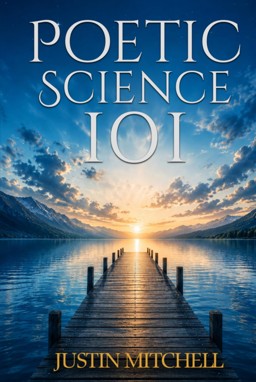

Atlanta, Georgia Oct 8, 2026 (Issuewire.com) What if love could be studied like gravity? What if heartbreak had a formula? What if memory could be quantified, while the mysteries of belief reached beyond what reason could explain?
In his newly launched poetry collection, Poetic Science 101, author Justin Mitchell brings that tension between the measurable and the deeply personal onto the page. Separation, fatherhood, spirituality, freedom, time, and human connection become points of reflection as he considers what happens when certainty gives way to experience.
The opening poem establishes this approach by placing human attachment alongside gravity, flight, war, space, and existence itself. Mitchell wonders whether such a bond has been encountered before, whether something intangible can still be unmistakably real, and how much a person might risk for it.
I wrote Poetic Science 101 because some of the most important things we experience cant be measured, said Justin in a recent interview. We can measure time, distance, gravity, and the physical world, but how do you measure love? How do you measure missing your children, holding on to faith, losing someone, or becoming different from who you used to be? Poetry gave me a way to ask those questions, even when I didnt have the answers.
Mitchell brings together forms of language rarely found in the same conversation. Scientific concepts encounter biblical imagery; romantic longing sits beside military terminology; intimate confession expands into reflections on God, regret, identity, and human connection. Darkness and light, seasons and space, imprisonment and freedom, heaven and the physical world provide contrasting images for experiences that refuse simple definition.
Romance, however, is only one dimension of the book.
Fatherhood produces some of its most vulnerable writing. Mitchell reflects on separation from his sons and the painful uncertainty of wondering how the years have changed themor whether they still remember him. In Still I Too, Love You, parental devotion becomes a paradox: caring more intensifies the pain, yet caring less is impossible.
Spirituality adds another layer. References to God, Jesus, sin, redemption, resurrection, and divine purpose reveal a speaker wrestling with belief rather than presenting it as an effortless source of certainty. Conviction and doubt occupy the same pages, allowing spiritual struggle to become part of a broader attempt to understand suffering, responsibility, and purpose.
Elsewhere, Mitchell confronts loneliness, military experience, race, social judgment, psychological struggle, confinement, regret, and the desire for personal freedom. As the poems progress, the focus gradually changes. A speaker once preoccupied with what others might feel or choose begins looking inward, confronting his own decisions, responsibilities, relationships, and evolving sense of self.
This progression gives Poetic Science 101 much of its depth. Rather than presenting a theory about human attachment or a formula for surviving loss, Mitchell documents the uncertainty itself, the attempt to understand experiences that continue to affect us long after circumstances have changed.
By the end, the distinction between science and poetry becomes increasingly significant. One seeks to quantify and explain; the other creates room for experiences that cannot always be reduced to evidence, equations, or definitive conclusions.
Perhaps poetry is not the answer. Perhaps it is where we learn how to ask the question.
Perfect for readers who appreciate contemporary verse with an introspective and unconventional voice, Poetic Science 101 speaks to experiences of parenthood, separation, spirituality, identity, personal change, and resilience. Mitchells blend of scientific metaphor, biblical references, military imagery, and candid reflection offers a distinctive approach to the contradictions that accompany being human.
Poetic Science 101 is now available on Amazon. For more information about the author and his books, visit his official website at https://authorjustinmitchell.com/.
About the Author
Justin Mitchell is a former Navy Petty Officer First Class, data center building engineer, and disabled veteran whose journey from science to poetry was shaped by resilience and transformation.
After an administrative separation following a schizophrenia diagnosis, Justin turned his background in submarine nuclear propulsion into a new form of exploration, writing poetry that examines love, loss, faith, memory, and the human experience. Inspired by music and the world around him, Justin creates verses that bridge logic and emotion, discovering beauty in the unseen forces that connect us all.
Source :BMD Digital INC.
This article was originally published by IssueWire. Read the original article here.