Maryland property owner petitions U.S. Supreme Court in property takings case
Petition asks the Supreme Court to decide whether a property owner must first seek legislative change before

Press Release Disclaimer: This is a press release distributed through the XPR Media network. It has not been independently verified by our newsroom.
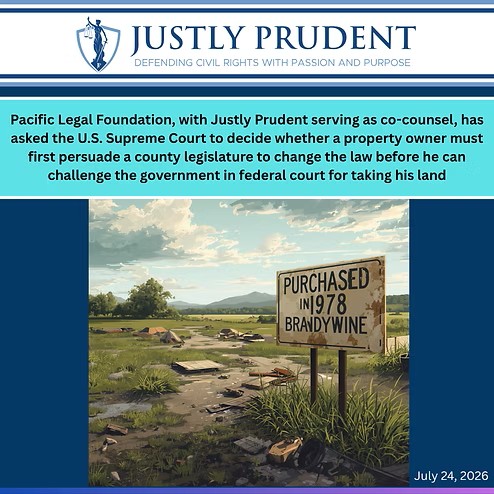

Petition asks the Supreme Court to decide whether a property owner must first seek legislative change before challenging a regulatory taking in federal court.
GREENBELT, MD, UNITED STATES, July 28, 2026 /EINPresswire.com/ — On July 23, 2026, Pacific Legal Foundation, with Justly Prudent serving as co-counsel, filed a petition for a writ of certiorari in the U.S. Supreme Court on behalf of Garnell Walls, a Prince George’s County, Maryland property owner. The petition asks the Court to review a February 23, 2026 decision of the United States Court of Appeals for the Fourth Circuit, which held that Walls’s Fifth Amendment regulatory takings claim was not ripe for review.
According to the amended complaint filed in the United States District Court for the District of Maryland, Walls purchased an undeveloped parcel on South Hill Road in Brandywine, Maryland in 1978, intending to build a single-family home. Court filings state that between 2019 and 2021 he spent approximately $40,000 obtaining permits and inspections, including a hydrological study and soil percolation testing, and that he recorded a woodland conservation easement over a portion of the property. The filings further state that the County approved his site development permit and his single-family dwelling permit.
Public water and sewer service is not readily accessible to the parcel. According to the amended complaint, the nearest public sewer line is more than one-half mile from the property and the nearest public water line is approximately 900 feet away, and the estimated cost of connecting the property to public service ranges from approximately $2.1 million to $2.5 million.
Under the County’s 2018 Water & Sewer Plan, installation of an interim private well and septic system requires a waiver from the County’s Department of Permitting, Inspections and Enforcement. The amended complaint states that County personnel advised Walls the agency would not approve a waiver for his property. In a February 2022 letter reproduced in the appellate record, the County informed Walls that the property “does not meet the criteria for a waiver” and identified the County Council’s legislative amendment process as the avenue available for changing the parcel’s water and sewer category.
Walls filed suit in May 2023 under 42 U.S.C. § 1983, asserting that the County’s refusal amounted to a taking of his property without just compensation. The district court granted the County’s motion to dismiss, concluding that the claim was not ripe. The Fourth Circuit affirmed in an unpublished per curiam opinion, holding that the County had not reached a final decision regarding the property because it could still authorize the interim system through a water and sewer category amendment enacted by the County Council. The Fourth Circuit denied rehearing on March 23, 2026.
The certiorari petition presents two questions. The first is whether a property owner must exhaust legislative remedies in order to ripen an as-applied regulatory takings claim under the Fifth Amendment. The second is whether a court may dismiss such a claim on prudential ripeness grounds when the property owner has sufficiently pleaded jurisdictional standing.
According to the petition, courts are divided on both questions. On the first question, the petition identifies the Ninth Circuit and the courts of Virginia, California, New York, Ohio, Michigan, and Hawaii as declining to require exhaustion of legislative remedies, and the Fourth Circuit, along with courts in Illinois, Florida, Georgia, and Wisconsin, as requiring it. On the second question, the petition states that the Third and Eighth Circuits treat ripeness in takings cases as jurisdictional, while the Fourth, Fifth, Seventh, Ninth, and Tenth Circuits treat it as prudential, and that the Federal and Second Circuits have issued conflicting decisions within their own circuits.
Jonathan M. Houghton of Pacific Legal Foundation is counsel of record on the petition, joined by Deborah J. La Fetra. Jordan D. Howlette, Managing Attorney of Justly Prudent, is co-counsel and has represented Walls since the case was filed in 2023.
“Pacific Legal Foundation saw what this ruling means for ordinary property owners, and the nonprofit stepped in and built a petition worthy of the question,” said Attorney Howlette. “Mr. Walls has waited nearly 50 years to build on land he bought and paid for. He is not asking for special treatment. He is asking for a decision, and for a court willing to hear him.”
Related proceedings remain pending in Maryland state court. The case is Garnell Walls v. Prince George’s County, et al. (Case No. 25A1280), filed in the Supreme Court of the United States.
Justly Prudent is a general civil litigation and business law firm that provides comprehensive legal services across multiple practice areas, with particular aptitude in civil rights and constitutional tort litigation. While serving clients in matters ranging from complex commercial disputes to employment law, the firm maintains a steadfast commitment to advancing civil rights through impactful litigation against government misconduct and systemic constitutional violations. To learn more, visit Justly Prudent’s website at www.justlyprudent.com or call the main office at (202) 921-6080.
Lars Howlette
Justly Prudent
+1 202-921-7558
email us here
Visit us on social media:
LinkedIn
Bluesky
Instagram
Facebook
Legal Disclaimer:
EIN Presswire provides this news content “as is” without warranty of any kind. We do not accept any responsibility or liability
for the accuracy, content, images, videos, licenses, completeness, legality, or reliability of the information contained in this
article. If you have any complaints or copyright issues related to this article, kindly contact the author above.

Media gallery