Metal Recycling Market to Add $357,570 Million by 2035, Expanding at 6.54% CAGR
NEW YORK, NY, UNITED STATES, September 15, 2026 /EINPresswire.com/ -- The global metal recycling market is becoming an

Press Release Disclaimer: This is a press release distributed through the XPR Media network. It has not been independently verified by our newsroom.
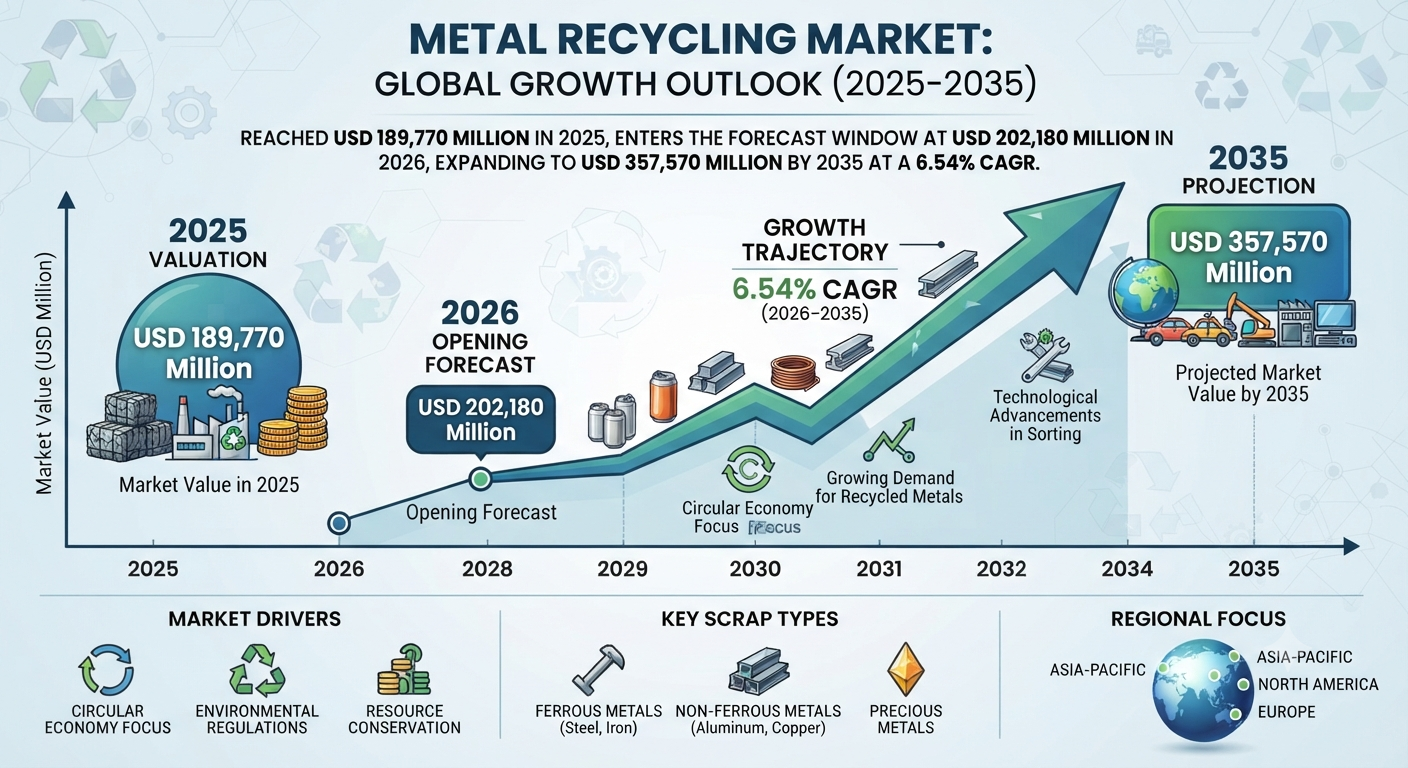

NEW YORK, NY, UNITED STATES, September 15, 2026 /EINPresswire.com/ — The global metal recycling market is becoming an increasingly important part of the circular economy as industries seek to reduce waste, conserve natural resources, lower carbon emissions, and secure reliable supplies of secondary raw materials. Recycling metals such as steel, aluminum, copper, iron, and other non-ferrous materials allows manufacturers to recover valuable resources from discarded products and industrial scrap while reducing dependence on primary raw-material extraction.
According to the latest Market Research Future (MRFR) analysis, the global metal recycling market reached approximately USD 189,770 Million in 2025 and is projected to increase to USD 357,570 Million by 2035, representing a 6.54% CAGR from 2026 to 2035. The market is estimated at approximately USD 202,180 Million in 2026.
What Is Metal Recycling?
Metal recycling involves collecting, sorting, processing, and converting discarded metal products and scrap into usable secondary raw materials. Recycled metals can subsequently be used in manufacturing processes to produce new products.
The recycling process generally involves several stages:
Collection of scrap metal
Sorting and separation
Dismantling
Shredding
Baling
Melting
Refining and processing
Distribution to manufacturers
Metal recycling covers both ferrous metals, such as iron and steel, and non-ferrous metals, including aluminum, copper, lead, and other valuable materials.
Get Sample @ https://www.marketresearchfuture.com/sample_request/2201
Key Factors Driving Market Growth
Growing Demand for Sustainable Materials
Environmental sustainability is one of the strongest forces supporting the metal recycling industry.
Manufacturers are increasingly seeking recycled materials to reduce their environmental footprint and meet corporate sustainability objectives. Recycling metals can help conserve natural resources while reducing the energy and emissions associated with producing metals from virgin ores.
The increasing adoption of circular-economy principles is also encouraging companies to treat discarded metal as a valuable resource rather than simply as waste.
Expansion of Electric Arc Furnace Capacity
The growth of electric arc furnace (EAF) steelmaking is creating additional demand for scrap metal.
EAF facilities can use substantial quantities of recycled steel as their feedstock. As steelmakers invest in new EAF capacity, particularly in Asia-Pacific and other emerging manufacturing regions, demand for consistent, high-quality scrap is expected to increase.
MRFR identifies EAF capacity additions as one of the major drivers of the metal recycling market.
Decarbonization and Carbon Regulations
Carbon reduction targets are changing the economics of recycled metals.
Governments and industries are placing greater emphasis on reducing emissions from energy-intensive sectors such as steel and aluminum production. Secondary metal production can offer significant emissions advantages compared with some primary production routes.
Carbon-related regulations and mechanisms, including Europe’s carbon-border policies, are therefore increasing the value of lower-emission raw materials and encouraging manufacturers to increase recycled content.
Regional Market Outlook
Asia-Pacific
Asia-Pacific is the largest regional market, accounting for approximately 48.6% of global market value in 2025. The region is also projected to be the fastest-growing major market, with an estimated 7.20% CAGR.
Rapid industrialization, urbanization, infrastructure development, manufacturing expansion, and increasing steel production are supporting demand for recycled metals.
India, China, Vietnam, and Indonesia are particularly important markets as governments and manufacturers increase their focus on resource efficiency and domestic scrap collection.
Europe
Europe accounted for approximately 21.3% of market value in 2025.
The region has a strong recycling ecosystem supported by environmental regulations, circular-economy policies, and growing demand for low-carbon materials.
Carbon regulations are also encouraging steel and aluminum producers to increase the use of secondary feedstock.
North America
North America represented approximately 20.4% of the market in 2025. The region benefits from established scrap collection networks, large automotive and construction industries, and continued investment in recycling and EAF steelmaking capacity.
The region is also seeing investment in battery recycling and advanced sorting technologies.
Middle East and Africa
The Middle East and Africa region is emerging as an important growth market, with MRFR forecasting approximately 7.05% CAGR.
Increasing industrialization, new furnace capacity, infrastructure investment, and growing interest in resource efficiency are expected to create new recycling opportunities.
Buy Now @ https://www.marketresearchfuture.com/checkout?currency=one_user-USD&report_id=2201
Challenges Facing the Metal Recycling Market
Despite strong growth prospects, the industry faces several challenges.
Scrap Contamination
Contamination remains one of the biggest challenges for recyclers.
Mixed materials, coatings, paint, plastics, copper residues, and other contaminants can reduce the quality of recovered metal and increase processing costs.
Advanced sorting and analytical technologies can help, but they require additional capital investment.
Collection Infrastructure
Many emerging markets still lack organized collection networks.
Informal collection can recover substantial quantities of scrap, but inconsistent quality control, limited traceability, and fragmented transportation networks can make it difficult to integrate these materials into formal supply chains.
Developing organized collection centers, digital weighing systems, and formal recycling networks could unlock substantial volumes of recyclable material.
Metal Price Volatility
Metal recycling businesses are exposed to fluctuations in commodity prices.
Changes in steel, aluminum, copper, and other metal prices can significantly affect the profitability of recycling operations.
Recyclers must therefore manage inventory carefully and develop strong relationships with downstream manufacturers.
Energy and Operating Costs
Shredding, melting, sorting, and refining can require substantial amounts of energy.
High electricity prices can place pressure on recycling margins, particularly in regions where energy-intensive processing is expensive.
Energy-efficient equipment and renewable power sources can help reduce operating costs and improve the environmental profile of recycling facilities.
Major Opportunities
Low-Residual Scrap
Manufacturers increasingly require consistent, high-quality scrap with low levels of unwanted elements.
Recycling companies capable of producing certified, low-residual feedstock can potentially command higher prices and secure long-term supply agreements.
Digital Traceability
Digital platforms can track scrap from collection through processing and delivery.
Traceability can provide information about material composition, recycled content, emissions, and chain of custody. This is becoming increasingly important as manufacturers face greater sustainability-reporting requirements.
Emerging-Market Collection Networks
Countries with rapidly growing industrial activity but underdeveloped recycling infrastructure represent significant opportunities.
Establishing formal collection networks, local processing centers, and efficient transportation systems can increase the supply of recyclable metals while creating new employment and economic opportunities.
Selective Demolition
Selective demolition allows contractors to recover metals before buildings are completely dismantled.
This approach can improve material quality and increase recovery rates while reducing the amount of construction waste sent to disposal facilities.
Read More @ https://www.marketresearchfuture.com/reports/metal-recycling-market-2201
Future Outlook
The metal recycling industry is expected to become increasingly automated, data-driven, and integrated with industrial supply chains.
By 2035, recycling companies are likely to place greater emphasis on material purity, traceability, carbon accounting, and direct relationships with manufacturers.
Autonomous sorting systems could become more common as artificial intelligence and machine vision improve. Recycling facilities may increasingly operate as sophisticated material-processing centers rather than conventional scrap yards.
The growth of electric vehicles, renewable energy, data centers, and power infrastructure should also support demand for recycled copper and aluminum.
At the same time, the expansion of EAF steelmaking is expected to strengthen demand for high-quality ferrous scrap.
Browse More Reports:
Construction Aggregate Market https://www.marketresearchfuture.com/reports/construction-aggregate-market-1545
Concrete Surface Retarders Market https://www.marketresearchfuture.com/reports/concrete-surface-retarders-market-6738
Asphalt Shingles Market https://www.marketresearchfuture.com/reports/asphalt-shingles-market-7172
Welded Pipes Market https://www.marketresearchfuture.com/reports/welded-pipes-market-7976
Builder Hardware Market https://www.marketresearchfuture.com/reports/builder-hardware-market-7996
Ventilation Grill Market https://www.marketresearchfuture.com/reports/ventilation-grill-market-8354
drone bridge inspection services market https://www.marketresearchfuture.com/reports/drone-bridge-inspection-services-market-40885
Market Research Future
Market Research Future
+1 855-661-4441
email us here
Legal Disclaimer:
EIN Presswire provides this news content “as is” without warranty of any kind. We do not accept any responsibility or liability
for the accuracy, content, images, videos, licenses, completeness, legality, or reliability of the information contained in this
article. If you have any complaints or copyright issues related to this article, kindly contact the author above.

Media gallery